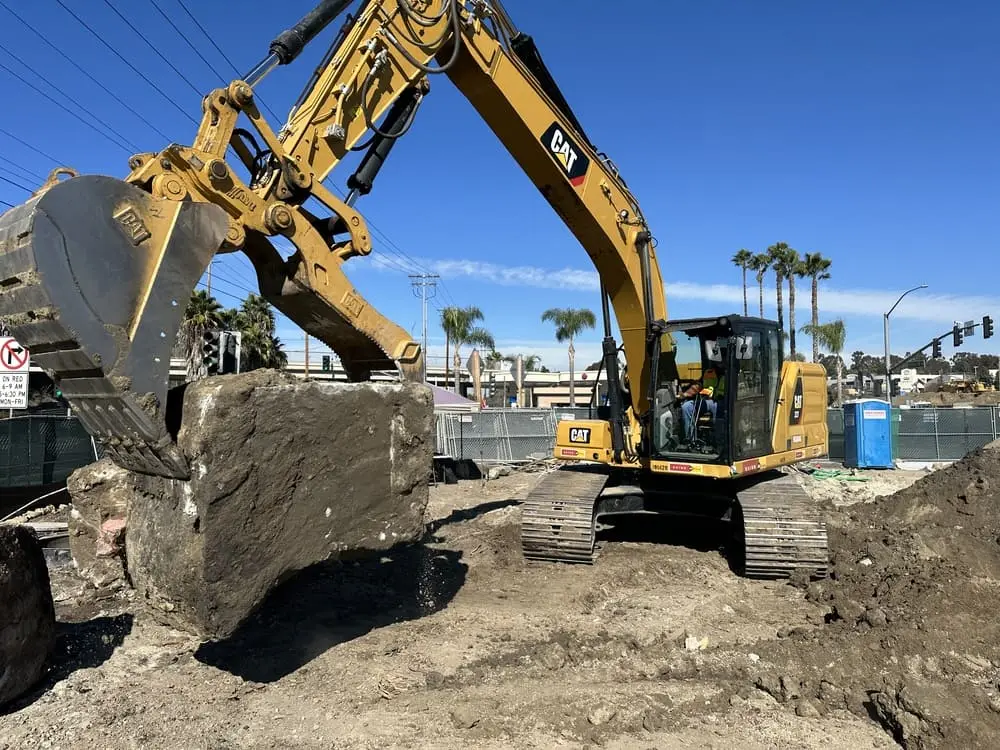
Partial or full removal – Utilities capped – Compacted backfill
Pool Removal Contractor in Orange County & Southern California
SoCal Removal drains and demolishes in-ground pools and spas, has the gas, water and electrical lines capped, and backfills in compacted lifts to the method your city and soils engineer require.
- CSLB #980451
- A, B, C-21, HAZ
- DIR 1000040690
- Southern California
Two Ways to Remove a Pool
Partial removal or full removal: your city decides
Every in-ground pool comes out one of two ways. The method sets the price, the schedule and what the ground can be used for afterward, and not every city allows both.
Partial removal (pool fill-in)
The pool is drained, the coping, bond beam and top of the shell are broken out, holes are punched through the floor so water can drain, and the hole is filled with rock and soil compacted in lifts. The lower shell stays in the ground.
- Lower cost, toward the low end of the $15,750–$31,500 range
- Usually limited to landscaping or open space afterward
- Building there later needs a geotechnical investigation first
- Not allowed everywhere: Covina requires full removal
Full removal
The entire shell, floor, rebar and coping come out, the debris is hauled off site, and the excavation is filled with engineered fill placed and tested under a soils engineer.
- Higher cost, toward the top of the range
- No concrete left in the ground
- Required in Yorba Linda wherever a structure, patio cover or deck will go
- No buried shell to disclose when the home sells
If anything may be built where the pool is, tell us before pricing. That usually points to full removal with tested fill, and changing methods after the shell is broken costs more than choosing it up front.
Local Requirements
How three local agencies handle pool removal
Requirements differ from one city to the next, sometimes by a lot. These three published handouts show the range. Handouts change, so we check the current version for your city when we price the job.
| Requirement | County of Orange (unincorporated) | Yorba Linda | Covina |
|---|---|---|---|
| Methods allowed | Partial removal with drain holes and a rock base, as described in the handout | Option A: shell stays, open space only. Option B: full removal, required where anything will be built | Full removal of the shell and equipment only |
| Floor openings (partial) | At least two 12 in. holes, one at the low point | At least three 2 ft square holes, plus one more per 50 sq ft of pool area | Not applicable |
| Rock base (partial) | At least 12 in. of #4 rock (1 to 2½ in.) | At least 12 in. of crushed rock (¾ to 1½ in.) | Not applicable |
| Broken deck or coping in the fill | Allowed on the rock, no piece over 3 in. | Allowed on the rock, no piece over 3 in. | Clean, certified fill only |
| Compaction | 90% relative compaction in structural areas; landscape areas compacted in lifts with no numeric standard | 90% relative compaction for both options; 8 in. maximum lifts for full removal | 90%, or as the soils report specifies |
| Reports | Geotechnical compaction report for structural backfill | Signed geotechnical engineer letter; soils report for full removal | Certified compaction report from a recognized lab |
| Utilities | Pool wiring and conduit removed; gas capped at the meter and the equipment | Electrical, gas and plumbing disconnected at their connections; breakers removed and blanked | Sub-panel feeders removed back to the service when a sub-panel comes out |
| Other | Inspection of the drain holes before backfill; final grading inspected for drainage | Owner acknowledgment and disclosure at sale for Option A; dump receipts at final | Permit to drain; grading permit over 25 cubic yards of fill; encroachment permit for street work; demolition bond |
Scale matters here. A 15 by 30 ft pool averaging 5 ft deep is about 83 cubic yards of hole, more than three times Covina’s 25-cubic-yard grading-permit threshold, and it takes more than that in loose fill to bring back to grade after compaction.
Pool Types
Every type of pool, spa and backyard feature
Construction type changes how a pool is broken out, what can stay in the ground and how the debris is handled.
01
Gunite and shotcrete pools
The common Southern California pool: a steel-reinforced concrete shell finished with plaster, pebble or tile. The shell is broken with an excavator-mounted hammer, the concrete is loaded out for recycling and the rebar is separated.
02
Fiberglass pools
A one-piece factory shell set on a sand or gravel base. It does not break into fill the way concrete does, so it is cut into sections and hauled out, then the hole is backfilled and compacted.
03
Vinyl liner pools
A liner hung on steel or polymer wall panels over a sand or concrete floor. The liner, panels, bracing and coping come out, and any concrete footing or collar is broken out.
04
Above-ground pools
Dismantled and hauled away. The electrical circuit is disconnected, the pad or sand base is removed and the ground is leveled.
05
Spas and hot tubs
An attached in-ground spa comes out with the pool. A freestanding concrete spa is removed like a small pool, and a portable hot tub is disconnected and hauled.
06
Decks, walls and equipment pads
Coping, decking, raised bond beams, rock waterfalls, slides and the equipment pad can be part of the scope. Block walls run $170–$205 per linear foot with footings.
Gas, Water and Electrical
The lines to the pool are capped before anything is broken
Cal/OSHA requires utilities to be shut off, capped or otherwise controlled before demolition starts (8 CCR 1735(a)), and building inspectors check the caps at final.
- Gas lineA gas pool heater is fed by a line from the house meter. It is shut off, disconnected and capped at the meter and at the equipment. If the meter serves only the pool, the gas company shuts it off or pulls it. A propane heater’s tank is handled through the propane supplier.
- ElectricalPump, light, heater and automation circuits are disconnected and the wiring is pulled. The County requires the conduit removed too; Yorba Linda requires the breakers removed and blanked and lets conduit under concrete stay once the wire is out.
- Water and plumbingThe fill line is capped at the house supply, and the suction, return, skimmer and drain lines are removed or cut and capped at their connections.
- EquipmentPump, filter, heater, chlorinator and controls are removed and hauled. Gas and electrical disconnects are performed by appropriately licensed trades where the law requires.
DigAlert does not mark the pool lines
Before digging, the excavator outlines the dig area in white and notifies DigAlert (811) at least two working days, and no more than 14 calendar days, ahead. A DigAlert ticket is good for 28 days (Gov. Code 4216.2).
Utility owners mark their own lines, which generally end at the meter. The gas and electrical lines from the house to the pool equipment are private, so they are traced from the equipment pad back to the house before excavation.
Draining the Pool
Where the pool water goes
Pool water cannot simply go into the street. Where it goes depends on the city, the water chemistry and whether the pool is salt.
Sanitary sewer first
Orange County’s stormwater program says to send pool water to the sanitary sewer when possible, usually through the property’s sewer cleanout (H2OC pools and spas guidance).
Storm drain only if it qualifies
Water sent to a street or storm drain must be dechlorinated to 0.1 mg/L or less with a pH between 6.5 and 8.5, and some cities prohibit storm-drain disposal entirely. Covina requires a permit before a pool is drained.
What never goes down the drain
Saltwater pools go to the sewer or to landscaping that can absorb the volume, not the storm drain. Acid-cleaning water and filter media are never discharged.
Cal/OSHA
Cal/OSHA rules on a pool removal
A pool removal is demolition and, on a full removal, excavation. These are the Cal/OSHA requirements that apply most often, and they are built into how the job is planned and priced.
Supervision and a written survey
Demolition is done under the immediate supervision of a qualified person, and a written survey of the structure, including any adjacent structure that could be affected, is made before work starts and kept on the job site (8 CCR 1734).
Pool walls that hold back soil
A pool wall beside a house footing, a slope or a neighbor’s wall can be acting as a retaining wall. It cannot be demolished until the ground-movement hazard is addressed by sloping, shoring or underpinning (8 CCR 1735(d)(2)).
Excavation permit and protection
Cal/OSHA’s permit exemption covers excavation to build a pool (8 CCR 341(e)(6)), not to remove one. When a full removal leaves a hole 5 ft or deeper that a worker must enter, a Cal/OSHA excavation permit is required, and the excavation is sloped, benched or shored unless it is in stable rock (8 CCR 1541.1). We obtain a project permit when the work requires one.
Edges, access and inspections
A competent person inspects the excavation daily and after rain, spoil and broken concrete stay at least 2 ft from the edge, workers have a ladder or ramp to get out, and the open pit is barricaded (8 CCR 1541).
Silica dust from breaking concrete
Hammering a concrete shell is covered by the silica standard: water at the point of impact or shrouded dust collection, and a written exposure control plan (8 CCR 1532.3). Debris is kept wet to hold down dust (8 CCR 1735(t)).
Heat
Backyard work in summer falls under the heat illness standard: water, shade once it passes 80°F and high-heat procedures at 95°F (8 CCR 3395).
Backfill and Compaction
What goes back in the hole, and how it is tested
Backfill that is not placed and tested correctly can settle under lawns, patios and anything built later. The controls are rock for drainage, clean fill in thin lifts, and relative compaction verified by an independent tester.
- Bottom inspection first. The city inspects the floor openings on a partial removal, or the cleared excavation on a full removal, before any fill goes in.
- Rock drainage layer. Partial removals start with at least 12 in. of crushed rock in the bottom so water can pass through the broken floor.
- Small debris only. Where a city allows broken deck or coping in the fill, it goes on the rock in pieces no larger than 3 in.
- Fill in lifts. Clean sand or approved soil is placed in layers, moisture-conditioned and compacted. Yorba Linda limits full-removal lifts to 8 in.
- Tested to 90%. Structural areas, both Yorba Linda options and Covina require at least 90% relative compaction or the soils report’s number, confirmed by a geotechnical engineer or lab with compaction tests as the lifts go in.
- Report and final grade. The compaction letter or report goes to the inspector to close the permit, and the finished grade drains away without ponding.
Can you build where the pool was?
After full removal with engineered, tested fill, generally yes, following the soils engineer’s recommendations. After partial removal, the County of Orange treats the area as unsuitable for structures until a geotechnical foundation investigation is done, and Yorba Linda limits it to open space and requires disclosure when the home is sold.
In landscape-only areas, the County allows the top 18 in. to be planting soil, and Yorba Linda requires the top 2 ft to support vegetation.
Compaction testing and soils engineering are performed by an independent consultant, usually retained by the owner, and are not included in our removal price.
Access
Access decides the equipment, and the equipment decides the days
Most pool removals are behind a house. How equipment gets in and how trucks get loaded affect cost as much as the size of the pool.
The narrowest point
Measure the tightest spot between the street and the pool: gate, side yard, AC unit, gas meter or downspout. Wider access allows larger compact equipment and fewer days; narrow access means smaller machines and more handwork.
Fences and walls
A fence panel or gate can be removed and reset to get equipment in. A shared wall or fence needs the neighbor’s written consent before it is touched.
Hillside and below-street yards
Steep or stepped lots may need ramps, conveyors or smaller loaders to move concrete and fill, which adds time.
Protecting what stays
Driveways, lawns and hardscape on the haul path are covered, and sprinkler lines, landscape lighting and trees in the path are identified before equipment moves.
Trucks and the street
Concrete leaves and fill arrives by truck at the curb. Work in the public right-of-way can need an encroachment permit, and some cities, Covina among them, prohibit stockpiling fill or debris in the street.
HOAs and neighbors
HOA work hours, truck routes and approvals are confirmed before scheduling, and neighbors along the haul path are told when equipment and trucks will be moving.
Project Sequence
How a pool removal moves forward
Permits and inspections set the calendar more than the demolition does, so the sequence is planned around them.
- 01Site walk, measurements and your city’s method
- 02Permit, DigAlert ticket and utility plan
- 03Drain the pool to the sewer or as the city allows
- 04Disconnect and cap gas, water and electrical; remove equipment
- 05Break out the shell; bottom inspection
- 06Rock base and fill in tested, compacted lifts
- 07Final grade, reports and permit final
Pricing
What pool removal costs
Our published 2026 price for in-ground pool removal is $15,750–$31,500 per pool. Partial removal lands toward the low end and full removal with engineered fill toward the high end. Jobs start at the $3,750 minimum.
- Method your city requires
- Pool size, depth and shell thickness
- Access for equipment and trucks
- Decks, coping, walls and the equipment pad
- Import fill and trucking distance
- Not included: permits and city fees, soils engineering and compaction testing
Project Proof
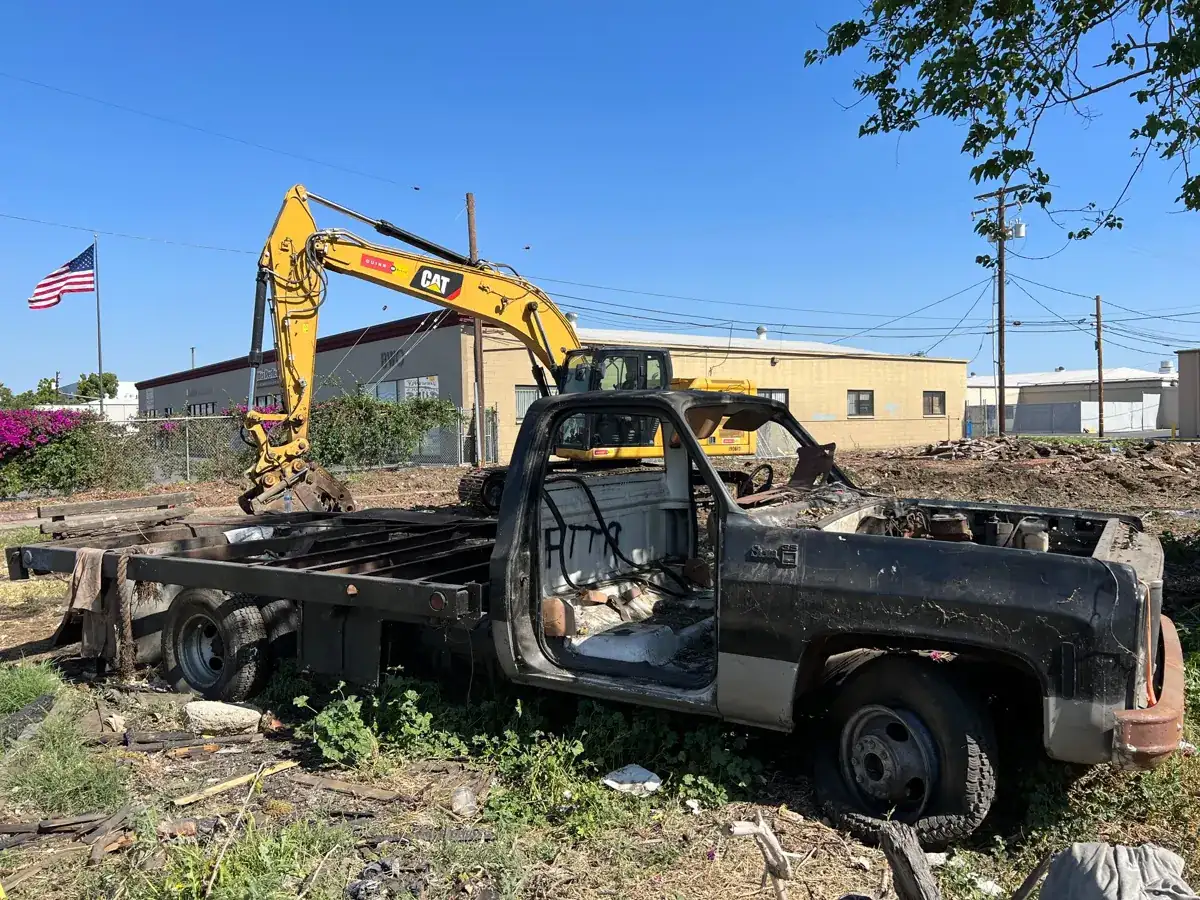
Fire-damaged property cleanup and pool removal, Anaheim
A combined demolition and cleanup scope at a fire-damaged residential property: burnt wood, concrete, brick and accumulated rubbish, plus below-grade features including a basement and an in-ground pool.
- LocationAnaheim, Orange County
- SettingResidential property
- ScopeCleanup, demolition, pool and basement removal
Pool Removal Questions
Pool removal FAQs
Can I just fill in my pool?
Often, but not everywhere. Filling in is partial removal: the pool is drained, the top of the shell is broken out, holes are punched through the floor and the hole is filled and compacted. Covina requires the whole shell removed. Where partial removal is allowed, the area is generally limited to landscaping unless a soils engineer later approves building on it.
Do I need a permit to remove a pool?
Expect one. The County of Orange, Yorba Linda and Covina all require a demolition or building permit, an inspection before backfill and a final inspection. Some cities add a grading permit, a permit to drain the pool or an encroachment permit for work in the street.
Who disconnects the gas line?
The gas line to the heater is shut off, disconnected and capped at the meter and at the equipment, and the inspector checks it at final. That work is done by an appropriately licensed trade where required. If the meter serves only the pool, the gas company is called to shut it off or remove it.
Do I need a soils engineer?
For full removal, structural areas and any city that requires 90% relative compaction, yes. A geotechnical engineer or testing lab observes the fill and issues the compaction letter or report the inspector needs. Yorba Linda requires a signed geotechnical letter even for partial removal. Testing is billed separately from our removal price.
Does Cal/OSHA require a permit for pool removal?
The permit exemption covers excavation to build a pool, not to remove one. When a full removal leaves a hole 5 ft or deeper that a worker must enter, an excavation permit applies, and we obtain a project permit for that work.
Do you remove fiberglass, vinyl and above-ground pools?
Yes, along with spas, hot tubs, decks, block walls, fences and equipment pads.
How long does pool removal take?
Permit review and inspection scheduling usually set the calendar more than the demolition does. Field time depends on the method, pool size, access and how quickly compaction testing and inspections can be scheduled. The proposal includes the schedule.
What do you need for a quote?
Photos of the pool, equipment pad and access path; the pool’s size and depth; the narrowest access width; what the area will be used for afterward; and your city’s pool removal requirements if you have them.
References
Requirements cited on this page
- County of Orange, Swimming Pool Demolition Requirements
- City of Yorba Linda, Procedure 003, Swimming Pool and Spa Demolition (rev. Feb. 2026)
- City of Covina, Handout #17, Pool and Spa Demolition
- H2OC (Orange County Stormwater Program), pools and spas guidance
- Cal/OSHA, Title 8: §341, §1532.3, §1541, §1541.1, §1734, §1735, §3395
- California Government Code §4216.2 (DigAlert notification)
This page summarizes published requirements for planning purposes. Your permit conditions, your city’s current handout and your soils engineer’s recommendations control the work.
Get a Quote
Send us your pool removal project
Start with the property city, the pool type and size, and what the area will be used for afterward. Add photos of the pool, the equipment pad and the access path. We will confirm your city’s method and the information needed for a defined proposal, including whether a site walk is needed.
Prefer to speak directly?
Call (949) 446-0000
Get a Quote
Use our project review form to share the pool details, location and photos. Your information helps us prepare the next step.