Precision Partial Removal
Selective Demolition for Renovation, Retrofit & Phased Work
SoCal Removal performs defined partial-removal work for commercial, industrial, residential and public projects across Southern California. We plan the contractor field scope around what comes out, what stays, what must be protected, how active operations are affected and what condition the next trade needs at handoff.
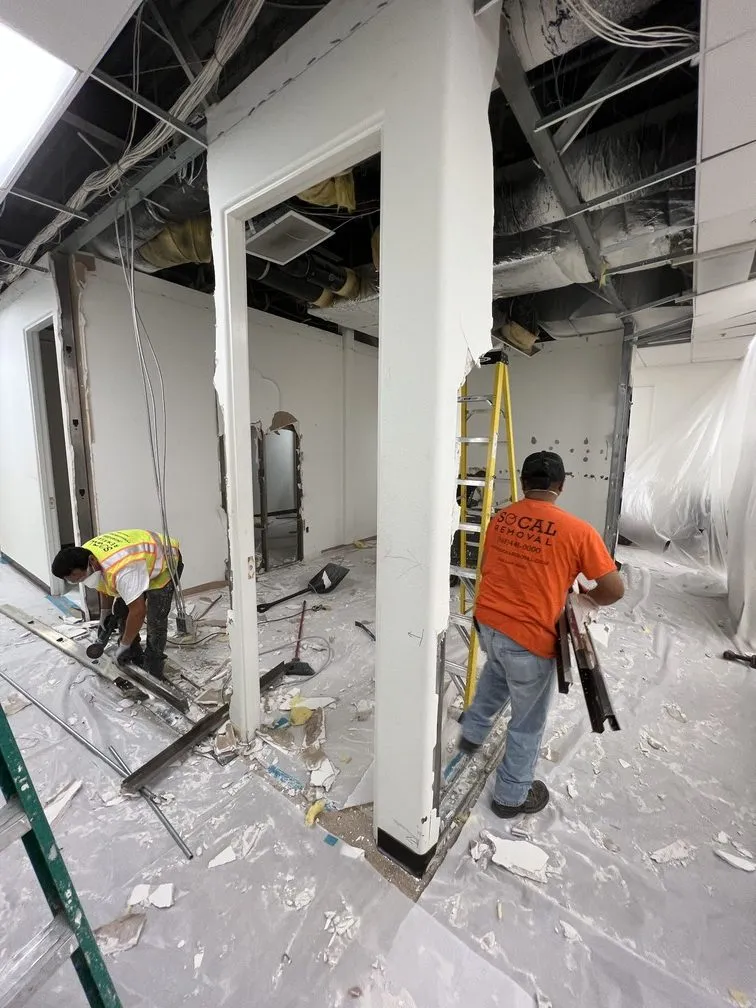
Project Readiness
Start With the Record You Actually Have
A useful review can begin with incomplete information. The certainty of scope, price and schedule depends on whether the project has issued limits, arranged documents and a release path for unknown conditions.
Reconcile the issued set
Compare demolition plans, specifications, structural details, finish plans, surveys, utility information, phasing and the required end state. Turn inconsistencies into RFIs, assumptions or priced qualifications before mobilization.
Build a controlled basis of price
Use photographs, a marked walkthrough and written inclusions to establish provisional limits. Label missing structural, utility, survey, access and turnover information as assumptions, allowances or release gates—not silent scope.
Pause, document and re-authorize
When the field does not match the issued record, control the affected area, photograph the condition, notify the authorized project representative and reconcile design, safety, schedule and cost impacts before the affected work resumes.
The proposal controls the contractor scope. A website description does not assign structural engineering, environmental consulting, utility work, regulated-material classification, permanent reconstruction or every possible specialty service.
Choose the Right Demolition Scope
Partial, Interior or Complete?
These services can overlap, but they should not compete for the same search intent or leave the owner guessing what the proposal includes.
Selective Demolition
Defined removal of particular components, openings, equipment, concrete, finishes or systems while adjacent construction or operations remain.
Use when the remove/retain/protect boundary drives the job.Interior Demolition
Tenant-improvement and renovation strip-out focused on interior finishes, partitions, ceilings, casework and assigned building-system interfaces.
Explore Interior DemolitionStructure Removal
Demolition of an entire building, detached structure or major structural system, including the site, utility, foundation and turnover decisions that follow.
Explore Structure RemovalThe Three-Color Plan
Remove. Retain. Protect.
A clear selective-demolition package turns every visible component and important concealed interface into one of three decisions. Ambiguous items belong in an RFI or allowance—not in a crew assumption.
Identify exact removal limits
Reference plans, elevations, room numbers, grid lines, equipment tags, cut lines, depths and limits. State whether fasteners, anchors, embedded items, substrates, foundations, haul-off and surface preparation are included.
- Walls, ceilings, flooring, casework and storefronts
- Slabs, trenches, pits, curbs and selected concrete
- Equipment, supports, piping and assigned system components
Define what stays
Name retained structure, finishes, equipment, systems and access paths. Record existing damage and the acceptance criteria for exposed edges, substrates, openings and downstream trade dimensions.
- Structural frame and adjacent construction
- Active utilities, life-safety systems and operations
- Salvage items and owner-furnished property
Assign protection and duration
Specify barriers, floor and finish protection, weather protection, vibration or dust controls, exclusion zones, debris routes and removal of temporary measures. Permanent restoration is separate unless expressly included.
- Occupied routes, exits and adjacent work areas
- Retained surfaces, equipment and sensitive operations
- Openings exposed to weather or public interfaces
Defined Work Packages
Typical Selective Demolition Scopes
Each card is a project category, not an automatic inclusion. Structural, system, hazardous-material, rigging, residual-content and reconstruction responsibilities are confirmed from the actual documents.
01
Interior reconfiguration
Partitions, ceilings, millwork, casework, kitchens, restrooms and selected finishes for tenant improvement or renovation.
02
Flooring and surface removal
Floor coverings, mastics, underlayment and assigned coatings, with substrate condition and preparation standard defined.
03
Concrete and access openings
Selective slab, curb, pit, vault and wall removal, saw cutting or trench access after structural, embedded-system and layout requirements are released.
04
Equipment and process interfaces
Machinery, conveyors, tanks, supports and process components after assigned parties document isolation, residual condition and handling requirements.
05
Steel and mezzanine components
Defined catwalk, platform, support and structural-steel removal following issued engineering, sequence and temporary-support direction.
06
MEP and utility exposure
Access and removal at assigned HVAC, plumbing, electrical or communications interfaces after required shutdown and specialty-trade work.
07
Doors, windows and storefronts
Controlled openings for replacement, access or retrofit, with temporary weather protection and permanent restoration stated separately.
08
Roof and seismic access
Assigned openings and selective removal supporting structural, roofing or seismic work under the design team’s details and acceptance criteria.
09
Industrial retrofit and decommissioning support
Phased access and removal around active or retired facility components, differentiated from full-system decommissioning and dismantling.
10
Damaged-material removal
Defined removal following fire, water, impact or deterioration after structural, environmental and insurance-sensitive conditions are documented.
Information Before Disturbance
What Makes a Useful Project Review
The best early package does more than circle an area on a floor plan. It connects removal limits to structure, systems, environmental information, occupied operations and the work that follows.
It can confirm visible conditions and access, but it does not certify structural adequacy, locate every concealed service or establish that regulated material is absent.
Ways to Reduce Uncertainty
These tools can reduce uncertainty, but they cannot guarantee every concealed condition or replace required surveys, engineering, utility releases, sampling or destructive verification.
- Record drawings, BIM and field markups
Overlay issued information, planning models, prior revisions and current remove-retain-protect markups, then identify every location that still depends on a field assumption.
- GPR, concrete scanning and radiography
GPR evaluates reflected radar signals, electromagnetic scanning responds to conductive targets, and radiography uses controlled ionizing radiation under specialized planning.
- Controlled exploratory openings and test cuts
Use design-authorized openings or cuts to verify selected assemblies, reinforcing, connections and system routes before committing to broader production limits.
- Current demolition, architectural, structural and MEP drawings.
- Remove / retain / protect markups and cut-line details.
- Written demolition survey and temporary-support assignment.
- Hazardous-material surveys covering the actual disturbance.
- Utility, energy-isolation, shutdown and trade-responsibility matrix.
- Occupancy, access, egress, work-hour and communication plan.
- Protection standard, debris route, loading area and haul requirements.
- Salvage ownership, recycling requirements and waste acceptance.
- Downstream dimensions, tolerances, finish and turnover condition.
- Bid date, phasing, target start and authorized change contact.
Pre-Disturbance Release Gates
Three Interfaces That Cannot Run on Assumption
These are planning checkpoints, not a site determination. The responsible project parties and each performing employer apply current requirements to the actual material, task, means and conditions.
Structure & Temporary Support
Complete the applicable written demolition survey. Where removal affects load paths, structural members or stability, the project engineer defines sequence, shoring, bracing and retained-condition criteria. SoCal Removal follows issued documents and does not provide structural engineering or certify retained construction.
Utilities, Energy & Residuals
Identify affected services and assign shutdown, disconnection, lockout, drain-down, capping, refrigerant recovery, purging or other isolation. Tanks, piping and machinery are released only after the responsible party documents the required energy and residual-content condition.
Regulated Materials & Exposure
Confirm survey coverage against actual limits and methods; match asbestos, lead, silica or other hazards to planned disturbance; assign consultant, laboratory, abatement and employer roles; complete required regulated work; then document the handoff before demolition resumes.
Asbestos: SoCal Removal’s CSLB record lists ASB for bidding purposes only. Required asbestos work is assigned to an appropriately licensed and, when applicable, Cal/OSHA-registered performing employer. Surveys, laboratory analysis, monitoring and clearance remain separately assigned. Review asbestos project planning. Lead: Demolition methods affecting lead-containing paint or coatings can trigger task-specific employer requirements. Review lead project planning. Concrete and masonry work is planned under task- and equipment-specific silica controls; describe the result as dust-controlled, not dust-free.
Responsibility Map
A Precise Scope Names the Decision-Makers
Final assignments come from the proposal, contract and issued project documents. Planning does not silently transfer another party’s professional, specialty-trade, facility or agency responsibility.
Client / Owner / General Contractor
Provides access, current records, project decisions, occupancy and phasing requirements, salvage ownership, accepted end state and timely authorization of changes.
Design & Environmental Team
Defines structural alterations, temporary support and retained-condition criteria; performs assigned surveys, sampling, interpretation, monitoring and clearance when required.
SoCal Removal
Plans and performs the contracted demolition work, including assigned protection, debris handling, field documentation and handoff.
Utilities, Facility Team & Specialty Trades
Perform or document assigned shutdowns, disconnects, caps, isolations, make-safe work, system changes, rigging or other specialty services before the affected scope is released.
Controlled Sequence
Precision Is a Process
The exact order changes by project, but a disciplined sequence keeps scope decisions, protection, production and downstream acceptance connected.
- 01
Review
Collect plans, specifications, surveys, photographs, schedule and end-state criteria.
- 02
Verify
Walk visible conditions, access, adjacent operations and apparent scope limits.
- 03
Mark
Reconcile remove, retain and protect decisions with issued details and RFIs.
- 04
Release
Close structural, utility, regulated-material, permit and specialty-party gates.
- 05
Protect
Install assigned barriers, routes, finish protection and work-zone controls.
- 06
Remove
Proceed in planned phases using methods suited to the retained conditions.
- 07
Manage
Segregate, load, recycle or dispose of accepted material streams and document variances.
- 08
Handoff
Clean the contracted area, reconcile limits and records, and present the agreed condition to the authorized party.
Occupied or active sites: Work can be phased around approved boundaries, access routes, shutdown windows and life-safety interfaces. Phasing can reduce disruption; it does not guarantee uninterrupted operations, zero dust, zero noise or zero vibration.
Existing Page Media
Selective Demolition in the Field
The source page’s strongest photographs show the useful middle of the story: deliberate disassembly around retained conditions and temporary protection planned before removal.
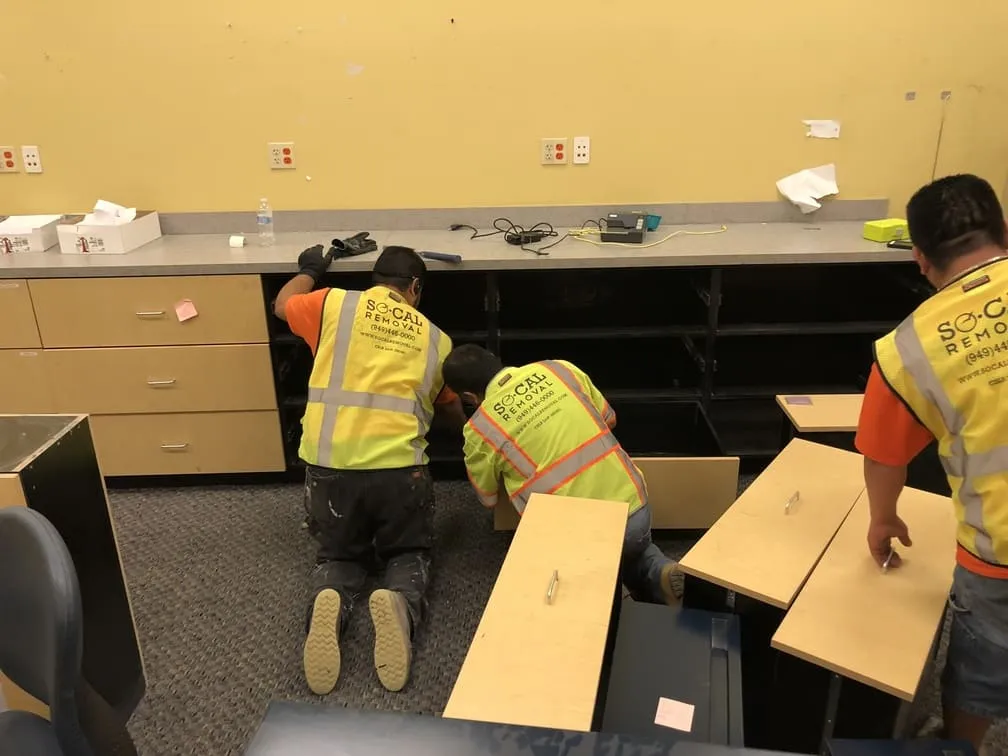
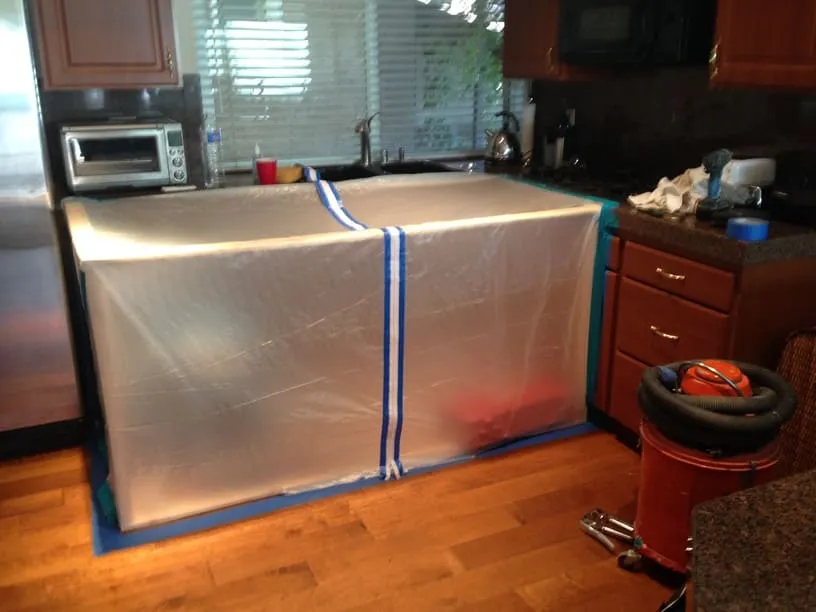
No before-and-after slider is proposed. The source contains two same-room work-in-progress images, not an authenticated before/after pair. A slider should be added only when the project, viewpoint, chronology, scope and publication rights are verified.
Changed Conditions
When the Field Does Not Match the Plan
Finishes often conceal utilities, reinforcement, structural framing, moisture damage, prior modifications, residual contents and suspect materials. Discovery is a decision point, not an invitation to improvise.
- Pause the affected activity
Limit additional disturbance without creating a new unsafe condition.
- Protect the interface
Control access and stabilize the immediate area as assigned.
- Document the condition
Record location, photographs, apparent extent and work already performed.
- Notify the decision-maker
Escalate to the authorized owner, contractor, designer, consultant or trade.
- Reconcile the impacts
Define testing, engineering, isolation, revised limits, controls, cost and time.
- Authorize before resuming
Proceed after required written direction and change documentation are in place.
Cost & Schedule Drivers
The Difficult Part Is Usually the Interface
Quantity matters, but selective-demolition pricing is often driven by protection, access, hand work, phasing, shutdowns, debris flow and the condition that must remain. Early clarity reduces avoidable allowances and change exposure.
- Removal quantity, material, thickness, fastening and access.
- Structural review, temporary support, scanning and layout.
- Occupied operations, work hours, shutdowns and phasing.
- Protection standard, sensitive areas, weather and life-safety interfaces.
- Regulated materials, exposure controls and required handoffs.
- Rigging, residual contents, equipment condition and specialty transport.
- Debris route, elevators, loading, trucking and receiving outlets.
- Salvage handling, recycling requirements and final facility records.
- Cut-edge, substrate, opening, cleanliness and turnover criteria.
- Concealed conditions, owner decisions and change-response time.
Practical Answers
Selective Demolition Planning Questions
These answers explain the planning boundaries. The project documents, written proposal and contract control the actual scope and responsibility assignments.
What is selective demolition?
Selective demolition removes specifically identified building components, finishes, equipment or systems while other portions of the property remain. The drawings, field markups and proposal should identify what is removed, retained and protected, together with access, sequencing, debris routes and the required handoff condition.
How is selective demolition different from interior demolition or structure removal?
Selective demolition is the broader precision-removal service and can include interior, exterior, structural, concrete, equipment and system interfaces. Interior demolition is primarily a nonstructural strip-out or tenant-improvement scope. Structure removal generally means complete or substantial removal of a building or major structure. The actual drawings and limits control the work package.
Can selective demolition be performed in an occupied or operating facility?
It can be planned around continuing operations when the project team defines work zones, access, egress, hours, shutdowns, temporary protection, dust and noise controls, debris routes and communication procedures. The proposal does not guarantee uninterrupted operations; impacts and hold points must be identified and arranged.
Who determines whether a wall, deck, opening or support can be removed?
The owner and design team provide the structural design, removal limits, required shoring or temporary support and acceptance criteria. SoCal Removal performs the authorized contractor scope and reports field conflicts. A website review or contractor walkthrough is not a structural-adequacy determination.
Who handles electrical, plumbing, HVAC and process-system shutdowns?
The project assigns identification, shutdown, lockout, disconnect, cap, make-safe and reconnection work to the serving utility or appropriately licensed and qualified trade. SoCal Removal arranges the demolition interface described in its proposal but does not assume every specialty-trade or facility-operations responsibility.
What happens if asbestos, lead or another suspect material may be disturbed?
Current project surveys and material information should be reviewed against the planned disturbance before work begins. Independent qualified parties perform surveys, sampling, laboratory analysis and clearance when required. The performing employer determines the applicable worker-protection and activity requirements for its work. If the issued record does not cover a discovered condition, the affected activity pauses for evaluation and written direction.
Can removed materials be salvaged or recycled?
Potential salvage and recycling streams can be identified during planning, but recovery depends on material condition, contamination, dismantling effort, schedule, market and receiving-facility acceptance. The proposal should state any specific salvage obligation or diversion requirement; no quantity is guaranteed unless expressly agreed.
What information helps produce a reliable selective-demolition proposal?
Provide current demolition and construction drawings, remove-retain-protect markups, structural details, available hazardous-material surveys, utility and shutdown information, occupancy and phasing requirements, finish-protection standards, access and debris routes, downstream dimensions or tolerances, schedule and the required turnover condition.
How are concealed or changed conditions handled?
Work in the affected area may pause while the condition is stabilized as appropriate, photographed and documented. The owner, general contractor, design team, consultant or assigned trade evaluates the impact. Revised limits, controls, price and schedule are addressed through written direction or a change order before affected work resumes.
Plan the Cut Before the Crew Arrives
Send the Limits, Constraints and Required End State
Share the current drawings, remove-retain-protect markups, photographs, structural details, surveys, utility and shutdown information, occupancy and phasing requirements, access, schedule and turnover criteria. We will identify scope gaps, assigned-party interfaces, allowances and the next information needed before firm pricing or mobilization.