Asbestos Abatement in Orange County
SoCal Removal takes on asbestos popcorn ceilings, floor tile and mastic, drywall and duct wrap before demolition and renovation across Orange County. All asbestos removal, whatever the size, is performed by a Cal/OSHA-registered abatement contractor under subcontract to SoCal Removal. Budget pricing runs $9.50 to $12.75 per square foot for popcorn ceilings and $17 to $23.50 for floor tile and mastic. Minimum charges apply (from $1,950 per job), and unit costs typically come down on larger commercial jobs. The survey comes from an independent Certified Asbestos Consultant, hired by the owner or brought in by us, and we schedule the SCAQMD notice and the demolition around the abatement.

Orange County & Southern California
Asbestos abatement before your next construction phase
Based in Santa Ana, SoCal Removal helps owners, property managers and general contractors define asbestos-related work before demolition or renovation. Send the project city, planned work and any existing survey so we can review the contractor scope, access and sequence with the assigned qualified parties.
Planning the work that follows? Review our demolition services, renovation and tenant improvements, and completed project examples. Projects elsewhere in the state are reviewed for scope, staffing and mobilization. See our California service area.
Project Readiness
Start With the Right Path
Choose the condition that best matches your project to see the next step and the information to gather.
Send the complete current package
Provide the full report, laboratory attachments, plans or marked-up scope, project address, photographs, access conditions, occupancy information, work-hour restrictions, and desired schedule. We will identify scope gaps, responsibility interfaces, and items that may affect demolition or renovation sequencing.
Do not decide by appearance or age
The owner should retain an appropriately qualified independent professional to determine the survey scope for the planned demolition or renovation. A demolition survey is broader than a limited renovation survey because the affected work is different.
Pause the affected activity
Keep people out of the immediate area when that can be done without handling the material. Avoid sweeping, ordinary vacuuming, moving debris, or further disturbance. Notify the owner or project representative and obtain an independent project-specific evaluation before work resumes.
Important: This page identifies planning triggers. It does not diagnose a material, define a survey, or replace project-specific direction from a qualified professional or agency.
Common Triggers
Why the Survey Must Match the Work
Survey quality, affected components, homogeneous areas, layered systems, material condition, quantities, inaccessible locations, and the exact construction scope influence the next step.
- 01Complete Demolition
All affected building and site components.
- 02Selective Demolition
Only the documented affected work areas.
- 03Tenant Improvements
Occupied access and phased construction.
- 04Building Systems
Roofing, HVAC, piping, flooring, walls, and ceilings.
- 05Site & Utilities
Excavation, grading, buried components, and infrastructure.
- 06Damaged Conditions
Fire, water, impact, or deterioration-related damage.
- 07Concealed Materials
Previously untested layers or locations found during work.
Project type affects occupancy controls, access, documentation, prevailing-wage requirements, scheduling, procurement, and closeout. It does not change the need for a project-specific scope review.
Field Context
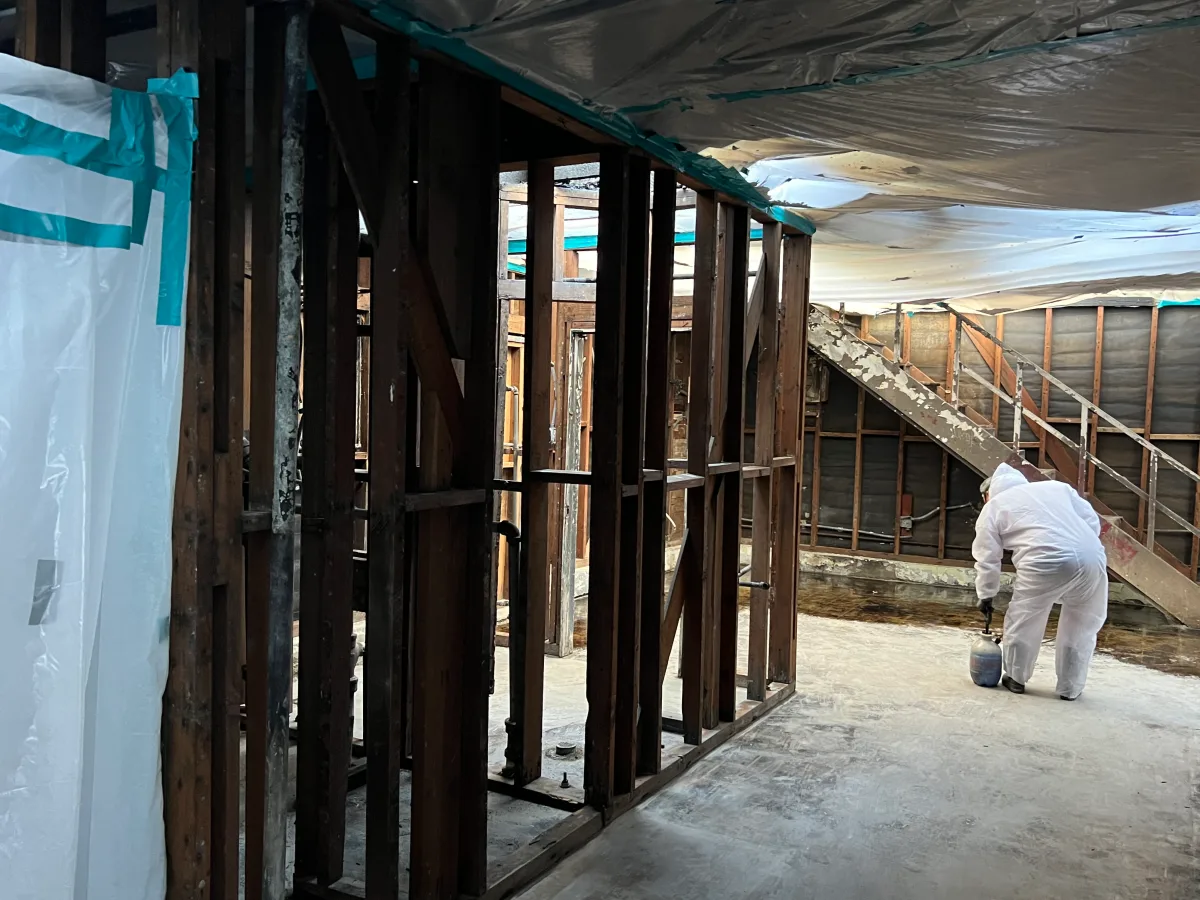
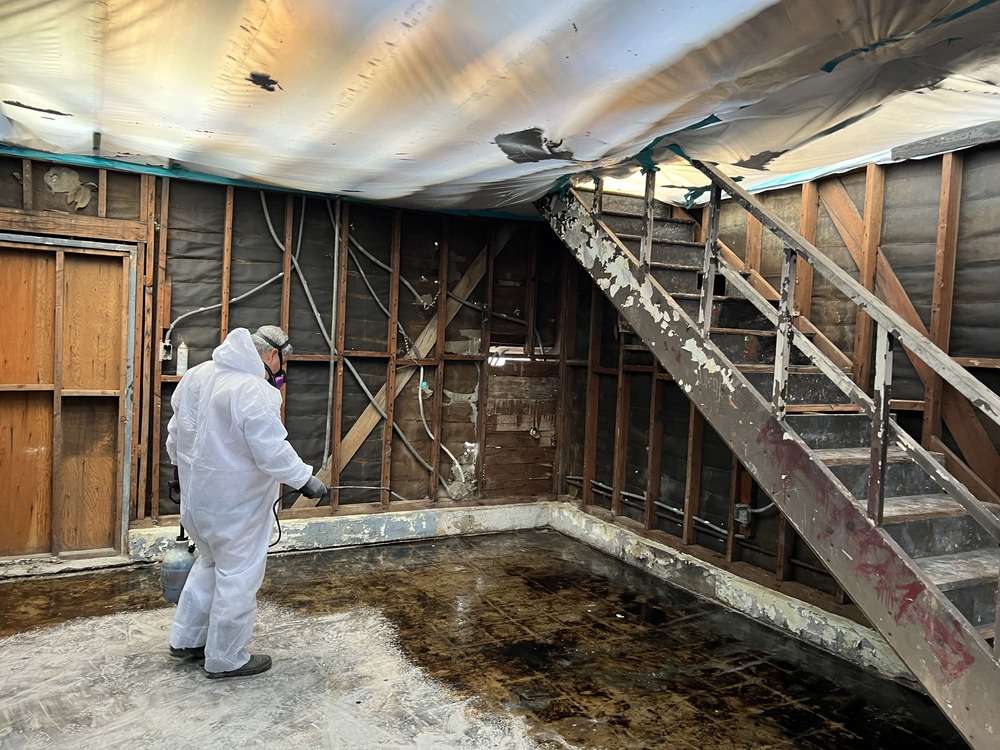
Photographs Help Define Access and Work-Area Conditions
These retained source-page photographs document visible people, equipment, barriers and interior conditions. They do not identify a material, establish the responsible contractor, select a removal procedure, or prove a compliance or clearance result.
See project examples: Crystal Cove Care Center abatement in Newport Beach and Bandini Library abatement and interior demolition in Commerce.

Suspect Building Materials
Where Asbestos May Be Present
Asbestos was used in many building products and systems. The examples below help owners and project teams ask better survey questions; they are not a visual identification guide.
Age, color, dimensions, trade name and appearance do not establish asbestos content. A qualified, scope-matched survey—and, where sampling is performed, associated laboratory records—must address the materials the project will disturb.

- 01
Roofing Systems
Roofing felt, flashing compounds, mastics, caulks, sealants and selected roofing products.
- 02
Attic & Concealed Insulation
Selected thermal-insulation products within attic, wall and concealed building assemblies.
- 03
Cementitious Exterior Products
Selected siding, panels, flues, pipes, fittings and other cementitious components.
- 04
Walls & Ceilings
Joint compound and tape systems, plaster, textured finishes, acoustic materials and fireproofing.
- 05
Flooring Systems
Resilient floor tile, sheet-flooring backing and associated mastics or adhesives.
- 06
Ductwork Components
Seam tape, paper or fabric wrap, register compounds and flexible vibration connectors.
- 07
Thermal System Insulation
Insulation on pipes, fittings, boilers, tanks, furnaces and related mechanical systems.
- 08
High-Temperature Components
Selected gaskets, packing, heat shields and boiler, furnace or access-door components.
- 09
Selected Electrical Components
Some older backing panels, arc chutes, heat shields, conduit products and wire insulation.
- 10
Other Project-Specific Materials
Window glazing compounds, sink undercoatings and selected decorative fireplace logs, embers or artificial ash.
Before Disturbance
Turn the Illustration Into a Scope Checklist
- 01
Identify the affected scope. Mark every assembly, layer and system the work may disturb.
- 02
Obtain a compliant survey. Match survey limits to demolition, renovation, excavation and access work.
- 03
Define condition and quantity. Reconcile locations, homogeneous areas, layers, damaged conditions and inaccessible areas.
- 04
Determine notices and controls. Assign qualified parties, project procedures, records and downstream release criteria.
If an unexpected suspect material is uncovered: stop disturbing it, restrict access, document the condition and obtain qualified evaluation before cleanup or continued demolition.
Document Review
Survey and Report Checklist
The project team should confirm that the current package actually covers the planned construction work. A laboratory result by itself is not the same as a complete survey. Review what an asbestos survey should address before demolition.
A limited report may be appropriate for a narrow renovation but may not address foundations, utilities, roofing, exterior materials, concealed systems, or other components affected by complete demolition.
Ways to Reduce Uncertainty
These tools can reduce uncertainty, but they cannot guarantee every concealed condition or replace required surveys, engineering, utility releases, sampling or destructive verification.
- Survey and sampling plan
Have the assigned qualified independent professional align survey limits, suspect materials, access constraints, sample locations and laboratory records with the planned disturbance.
- Controlled destructive investigation
Use authorized openings when concealed layers or inaccessible assemblies must be evaluated, with protection, sampling and restoration responsibilities established before opening.
- Homogeneous-area and layer mapping
Separate dissimilar materials and layers, then document their locations, quantities and conditions so one assumption is not applied across unlike assemblies.
- Correct property, project address, and affected work area.
- Full demolition or limited renovation scope identified.
- Responsible consultant or technician and current credentials.
- Laboratory information and complete analytical attachments.
- Material locations, homogeneous areas, layers, condition, and quantities.
- Sampling locations and materials presumed to contain asbestos.
- Roofing, exterior, foundation, utility, concealed, and inaccessible components.
- Damaged materials and areas needing separate evaluation.
- Amendments, addenda, drawings, photographs, and current revision date.
- Inputs needed for notices, pricing, sequencing, waste acceptance, and closeout.
Responsibilities
Clear Roles Keep the Project Moving
Client / Owner
Provides current documents, defines the affected construction scope, retains owner-assigned professionals, supplies access and decisions, and signs assigned owner or generator records.
Independent Professionals & Laboratory
Perform surveys, sampling, project design, monitoring, independent verification, clearance, and laboratory analysis under their respective qualifications and assignments.
SoCal Removal
Reviews the documented package and manages only its contracted demolition or renovation scope, logistics, sequencing, communication, and assigned records. It does not self-perform regulated asbestos abatement under its current public licensing status.
Authorized Project Parties
The performing asbestos contractor, agencies, carriers, and receiving facilities each control their assigned legal, contractual, notification, transport, acceptance, and record responsibilities.
ASB is currently listed by CSLB as “for bidding purposes only.” An appropriately licensed asbestos-abatement contractor must perform regulated removal and, where required, the performing employer must hold current Cal/OSHA registration. Utilities and agencies control their own reviews, inspections, enforcement, and approvals.
Project Terminology
Two Frameworks, Different Purposes
Cal/OSHA work classes and South Coast AQMD Rule 1403 procedures describe different parts of asbestos-related planning. Neither label, by itself, defines the complete scope, selects a work method, or assigns a contractor.
This section is not a work plan, agency approval, clearance result, licensing statement, or proof of self-performance. The current regulation, survey, material type and condition, quantity, planned task, written agency approvals, exposure assessment, competent-person direction, and project documents control. The assigned asbestos contractor owns its means, methods, controls, worker protection, and contractor records.
Laboratory Terminology
The Six Mineral Names a Report May Use
California's construction standard identifies six asbestos minerals. Chrysotile belongs to the serpentine family; the other five are amphiboles. The profiles below explain terminology a laboratory may use and why the complete report matters to project planning. Appendix K is a non-mandatory informational bulk-analysis method; it does not create additional obligations. Review Cal/OSHA's Appendix K.
Chrysotile
- Properties
- A magnesium-silicate mineral whose layered crystal structure curls into fine, generally flexible tubular fibers. “White asbestos” is a historical name, not a visual identification method.
- Abatement planning
- Chrysotile may occur in many different material matrices. The mineral name or reported percentage does not establish friability or release potential; confirm the exact layer, condition, quantity and planned disturbance.
Amosite
- Properties
- An iron-magnesium amphibole also identified as cummingtonite-grunerite asbestos. Amphibole fibers are generally straighter and more rigid than chrysotile. “Brown asbestos” is a historical name.
- Abatement planning
- Match the finding to the exact sample and building component. Work classification and controls follow the material, condition and activity—not the mineral name or color alone.
Crocidolite
- Properties
- A sodium-iron amphibole and the asbestiform variety of riebeckite. Its fibers generally have a straight amphibole form. “Blue asbestos” is a historical name, not a field test.
- Abatement planning
- Confirm the reported location, layer, matrix, condition and quantity before pricing. A positive mineral identification does not by itself select containment, wetting, PPE, waste or clearance requirements.
Tremolite Asbestos
- Properties
- A calcium-magnesium amphibole that can occur in asbestiform and non-asbestiform habits. The regulated name in this context is tremolite asbestos; it may also occur as an accessory mineral in other deposits or materials.
- Abatement planning
- Verify the report's exact wording, analytical method, sample identifier, material layer and consultant interpretation. Ambiguous terminology should be clarified before the final scope, price or work plan is set.
Actinolite Asbestos
- Properties
- A calcium-magnesium-iron amphibole in the tremolite-actinolite mineral series. The regulatory term addresses actinolite asbestos in an asbestiform habit, not every occurrence of the mineral.
- Abatement planning
- Read the result with the sample map, homogeneous area, product layer and planned disturbance. Do not convert the mineral name alone into assumed quantities, methods or disposal requirements.
Anthophyllite Asbestos
- Properties
- A magnesium-iron amphibole that is comparatively uncommon in historical commercial use. The regulatory name specifies anthophyllite asbestos in an asbestiform habit.
- Abatement planning
- Uncommon does not mean irrelevant. Tie the finding to the component, quantity, condition and affected task before the assigned parties establish controls, sequencing and closeout requirements.
Why the full report matters: Historical color names cannot identify asbestos in the field. Mineral identity helps a trained laboratory describe a sample, but it does not by itself determine friability, work class, removal method, containment, PPE, exposure controls, waste profile or clearance requirements. Those decisions require the complete survey and laboratory record, material matrix and condition, quantity, planned activity, site conditions, applicable requirements and the assigned qualified parties.
Air-District Framework
Rule 1403 Removal Procedures 1–5
For covered work within South Coast AQMD jurisdiction, Rule 1403 identifies five removal-procedure paths. One or more must be used when ACM is removed or stripped. The material, condition, task, and field conditions affect selection; Procedures 4 and 5 require written District approval. Read the current Rule 1403 text.
HEPA Filtration
Rule 1403 specifies an isolated work area, prescribed barriers and air controls, continuous negative-pressure HEPA filtration from removal through final cleanup, and adequate wetting.
- Client impact
- Containment footprint, temporary power, access, sequencing, and downstream release should be resolved before mobilization.
Glovebag or Mini-Enclosure
Rule 1403 permits glovebag or mini-enclosure removal when the system is designed and operated under the referenced federal Appendix G and current Cal/OSHA requirements.
- Selection limit
- Suitability is material- and project-specific. This is not a do-it-yourself alternative to a qualified contractor’s work plan.
Adequate Wetting
For nonfriable ACM only, Rule 1403 requires adequate wetting during cutting or dismantling and removal, drop cloths and tenting to the extent feasible, and non-power tools.
- Selection limit
- The documented material condition and planned activity govern whether this procedure is available.
Dry Removal
Prior written South Coast AQMD approval is required before dry removal when adequate wetting in the renovation work area would unavoidably damage equipment or present a safety hazard.
- Client impact
- Approval lead time, the exact approved controls, access, and schedule must be incorporated into the project plan.
Approved Alternative
Procedure 5 is a written, District-approved alternative combination of techniques or controls. Rule 1403 also requires it when covered material has fire, explosion or natural-disaster damage and for qualifying associated disturbance outside a containment or work area.
- Changed condition
- After immediate hazards are controlled, affected areas may need to be secured, stabilized, surveyed, and addressed under the required written approval before cleanup proceeds.
Illustrated Field Guide
See the Five Procedures in Context
These project illustrations make the five Rule 1403 paths easier to recognize. They are educational concept images—not approved plans, universal setups, or evidence that SoCal Removal self-performs regulated asbestos removal. Do not copy embedded example signage or labels; current regulatory wording and the project work plan control.
Read the captions with the artwork. The images contain legacy or simplified example signage, waste labels, monitoring displays, PPE, packaging and completion language. Do not use those embedded examples as field instructions. Current Rule 1403, 8 CCR 1529, written approvals, exposure assessment and project-specific documents control.
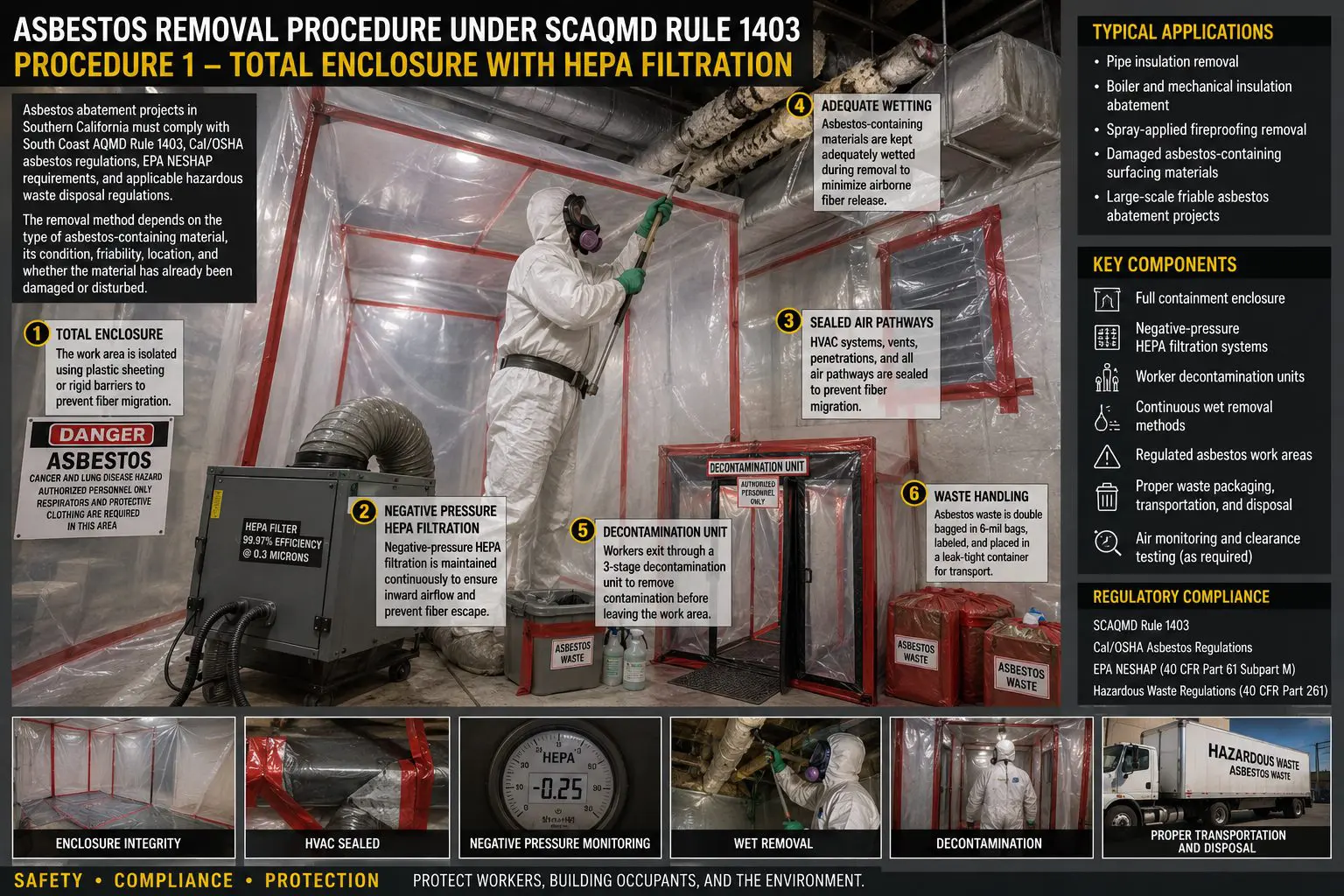 Concept illustration · current signage, labels, PPE and controls govern
Rule 1403 specifies an isolated work area, prescribed barriers, negative-pressure HEPA filtration, and adequate wetting. The illustrated three-stage decontamination, PPE, six-mil double-bagging and clearance examples are not universal Procedure 1 requirements.
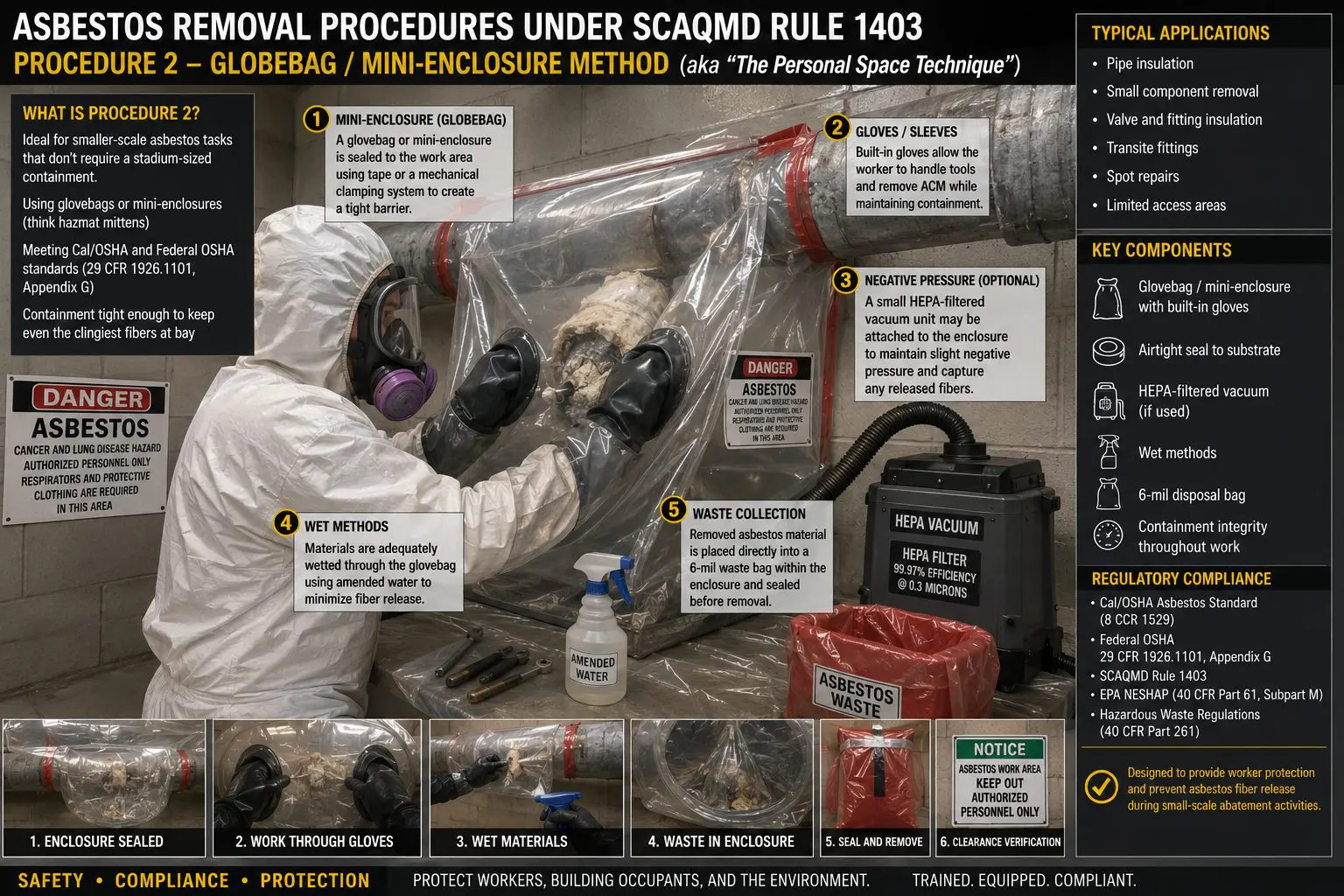 Concept illustration · current signage, labels, PPE and controls govern
The formal Rule 1403 name is Procedure 2—Glovebag. A glovebag and mini-enclosure are different systems governed by the referenced Appendix G and current Cal/OSHA requirements; the artwork's “globebag” spelling and nickname are not regulatory terms.
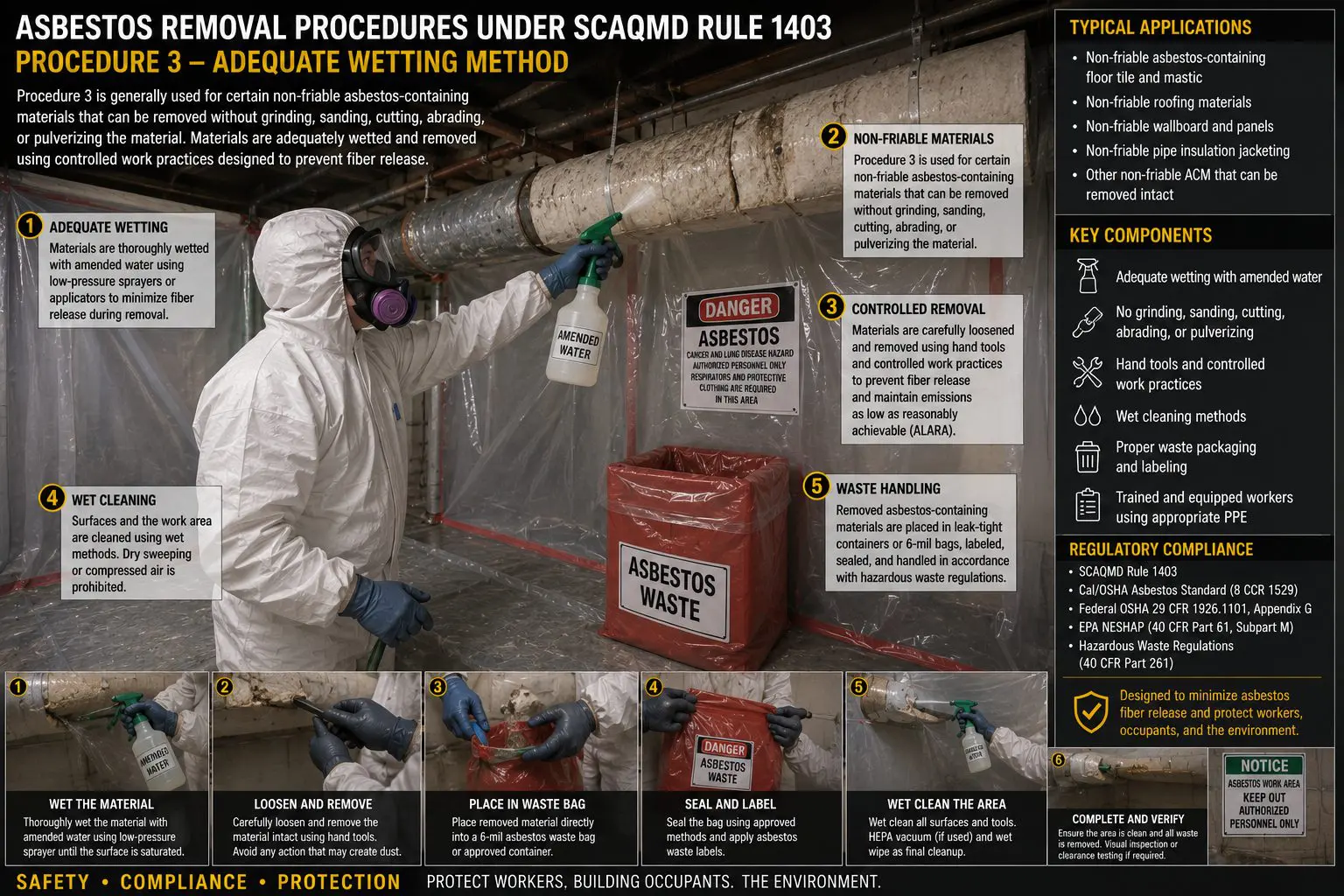 Concept illustration · current signage, labels, PPE and controls govern
This path is limited to nonfriable ACM. Rule 1403 requires adequate wetting, containment to the extent feasible and non-power tools; the artwork's “no cutting” shorthand is overbroad because the rule addresses cutting while adequately wet.
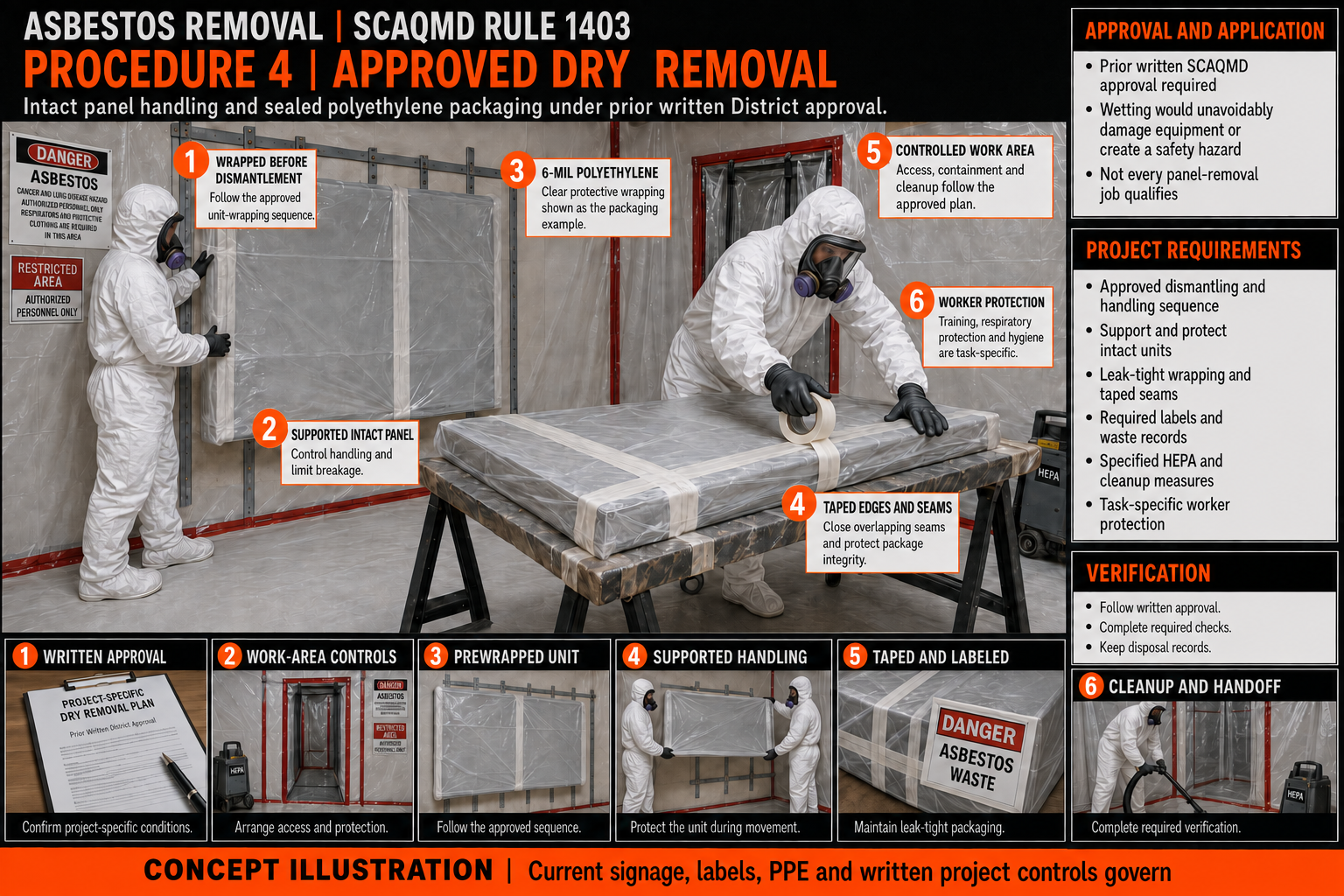
Prior written District approval is required when wetting in the renovation work area would unavoidably damage equipment or present a safety hazard. The written approval controls the actual safeguards. The illustration shows an intact-panel wrapping example; 6-mil wrapping alone does not qualify a project for Procedure 4.
View full-size Procedure 4 illustration
Procedure 4: numbered illustration notes
- Wrapped before dismantlement. Follow the approved unit-wrapping sequence.
- Supported intact panel. Control handling and limit breakage.
- 6-mil polyethylene. Clear protective wrapping is shown as a packaging example.
- Taped edges and seams. Close overlapping seams and protect package integrity.
- Controlled work area. Access, containment and cleanup follow the approved plan.
- Worker protection. Training, respiratory protection and hygiene are task-specific.
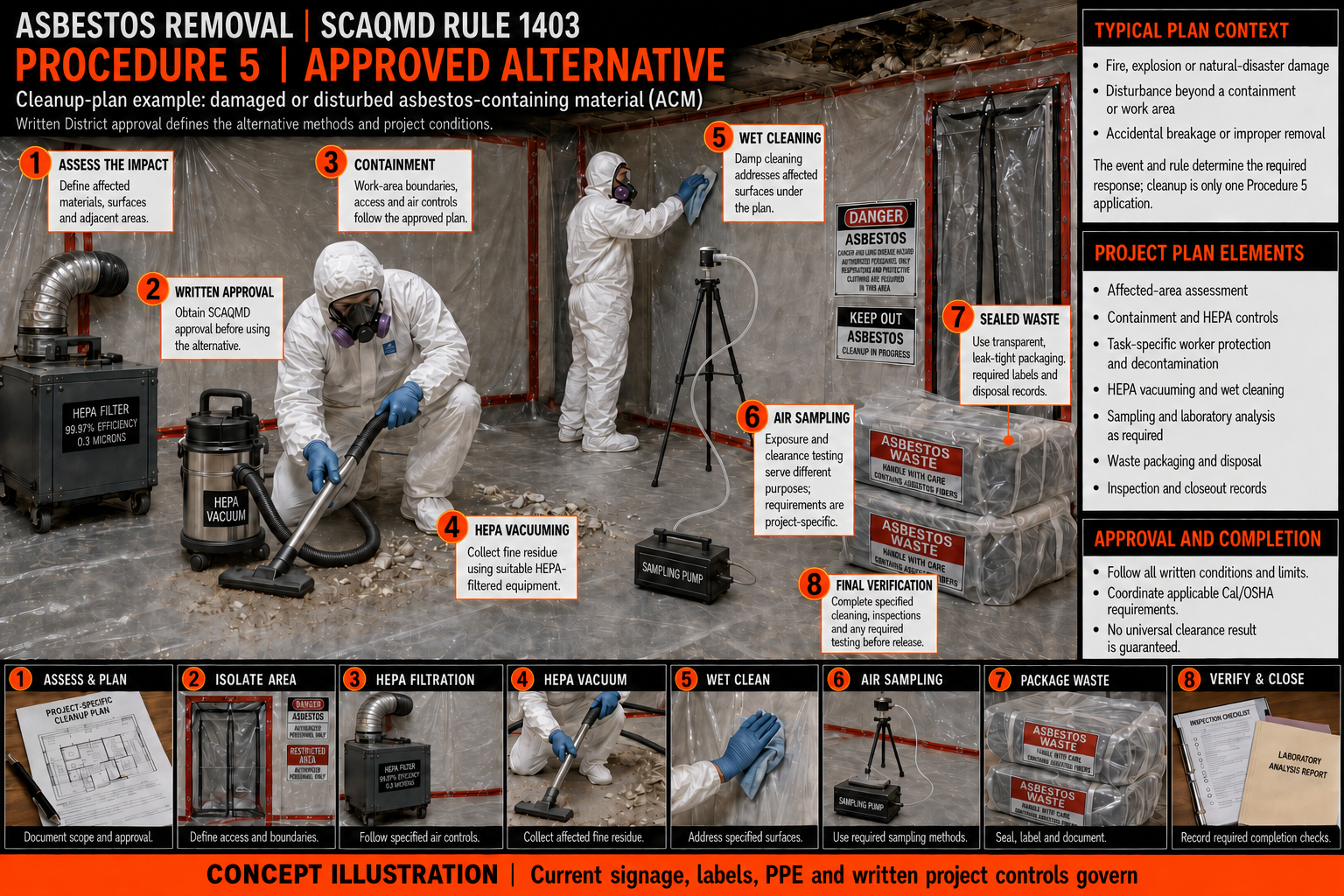
This is a written, District-approved alternative. Rule 1403 requires it for covered material damaged by fire, explosion or natural disaster and for qualifying associated disturbance outside a containment or work area. The rule does not create a universal air-clearance requirement; the approved plan and other applicable project requirements control.
View full-size Procedure 5 illustration
Procedure 5: numbered illustration notes
- Assess the impact. Define affected materials, surfaces and adjacent areas.
- Written approval. Obtain SCAQMD approval before using the alternative.
- Containment. Work-area boundaries, access and air controls follow the approved plan.
- HEPA vacuuming. Collect fine residue using suitable HEPA-filtered equipment.
- Wet cleaning. Damp cleaning addresses affected surfaces under the plan.
- Air sampling. Exposure and clearance testing serve different purposes; requirements are project-specific.
- Sealed waste. Use transparent, leak-tight packaging, required labels and disposal records.
- Final verification. Complete specified cleaning, inspections and any required testing before release.
Procedure boundary: The current rule and any project-specific written approval control. This overview does not select a method or prescribe the performing contractor’s equipment or work practices.
Worker-Activity Framework
Classes I–IV Describe the Work Operation
The class follows the material and activity—not a marketing label or a simple risk ranking. Exposure assessment, quantity, condition, work location, competent-person evaluation, and other provisions determine the controls that apply. Read California Code of Regulations, Title 8, Section 1529.
TSI and Surfacing Material Removal
Class I asbestos work involves removal of thermal system insulation or surfacing ACM or presumed ACM.
- Controls vary with
- Quantity, location, exposure assessment, adjacent occupancy, and the competent person’s selected control method.
Other ACM Removal
Class II asbestos work involves removal of ACM other than thermal system insulation or surfacing material, including certain wallboard, flooring, roofing, siding, and mastics when documented as ACM.
- Important distinction
- Class II is not synonymous with “low risk” or “nonfriable.” Material-specific controls, respiratory protection, hygiene, and monitoring requirements vary.
Repair and Maintenance
Class III asbestos work is repair or maintenance in which ACM or presumed ACM—including TSI or surfacing material—is likely to be disturbed.
- Important distinction
- The regulation’s disturbance definition and task-specific provisions control. A glovebag is one possible control for certain tasks, not a universal Class III method.
Maintenance and Custodial Contact
Class IV covers maintenance or custodial contact without disturbing ACM or presumed ACM, plus cleanup of dust, waste, or debris from Class I, II, or III work.
- Important distinction
- Class IV inside a regulated area can be subject to requirements of the higher-class work. If ACM is disturbed, the no-disturbance Class IV description no longer applies.
Illustrated Field Guide
See Classes I–IV as Work Activities
These illustrations help clients visualize the work categories. Class describes the activity; it is not a simple risk ranking or a fixed PPE, respirator, containment, monitoring, or decontamination package. Do not copy embedded example signage or labels; current Section 1529 and the performing employer's competent-person assessment control.
Class is an activity definition—not a risk score. The “high,” “lower,” or “lowest” risk banners and “minimum PPE” packages embedded in the illustrations are simplified concepts, not Cal/OSHA definitions. The performing employer's documented assessment determines the applicable controls.
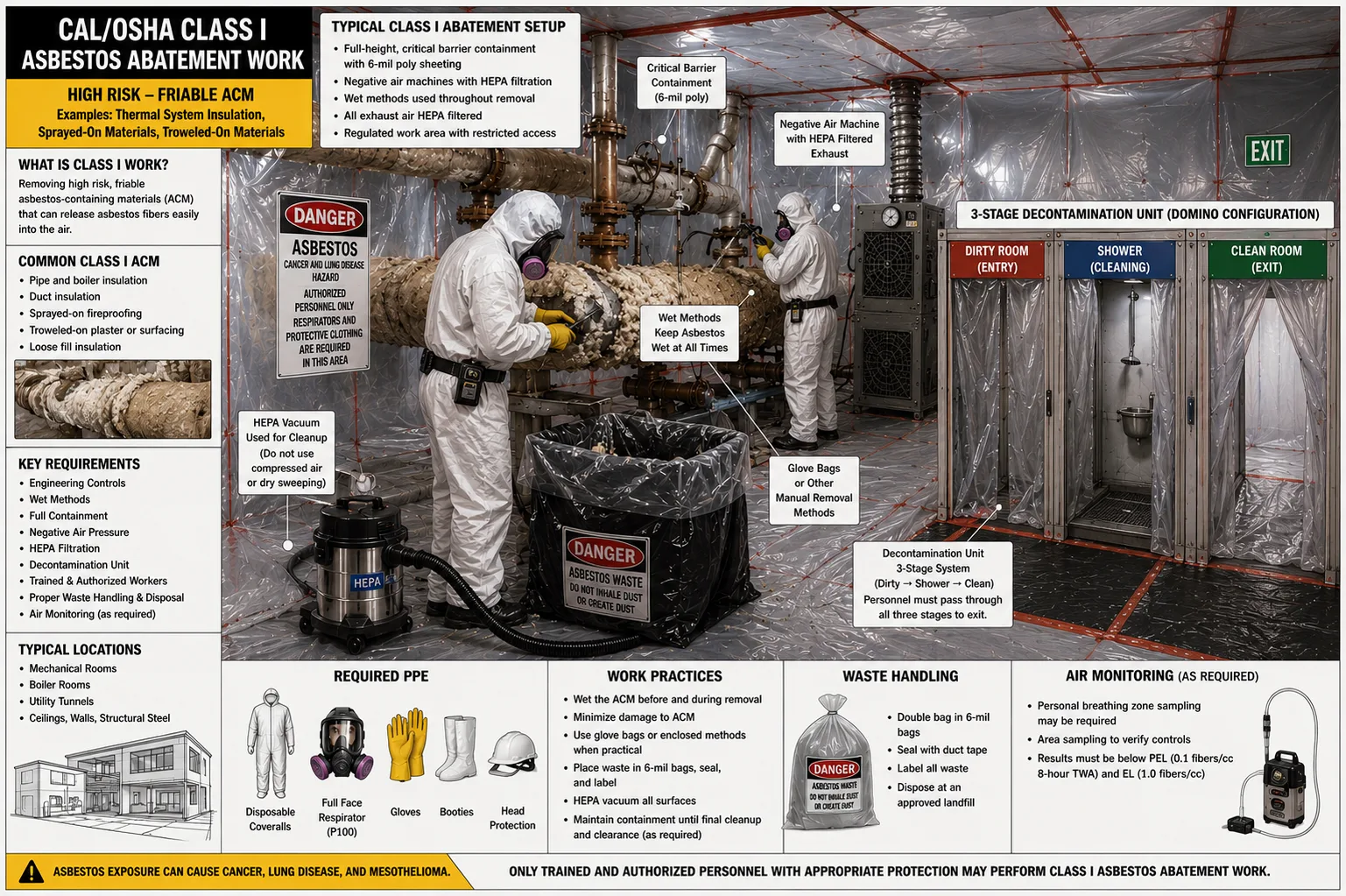
Class I is defined by the material and removal activity. The full enclosure, three-stage decontamination and depicted respirator are one project concept—not a universal Class I setup. Quantity, location and exposure assessment affect the controls.
Concept illustration · current signage, labels, PPE and controls govern.
Class I illustration: full size (opens in a new tab)
Class I: materials, controls and worker protection
- Materials and locations
- The illustration identifies pipe, boiler and duct insulation; sprayed-on fireproofing; troweled-on surfacing; and loose-fill insulation. Its location examples include mechanical rooms, boiler rooms, utility tunnels, ceilings, walls and structural steel. Survey findings establish the actual material and scope.
- Central work scene
- Workers address overhead insulation with wet methods and controlled removal. Nearby equipment illustrates HEPA vacuum cleanup, filtered exhaust and waste collection. Glovebags or other enclosed methods are shown as task-dependent options.
- Work-area controls
- The depicted enclosure has taped barriers, sealed openings, restricted access, warning signs and negative-pressure HEPA filtration. The air-filtration unit and the cleanup vacuum perform different jobs. The applicable setup follows the employer's assessment and selected method.
- Decontamination
- The three-stage concept shows an equipment or dirty room, shower and clean room. It separates contaminated work clothing and equipment from clean clothing and exit activities; it is not a universal layout for every Class I project.
- Worker protection and training
- The PPE illustrations show disposable coveralls, a full-face respirator with P100 filters, gloves, foot coverings and head protection. These are depicted equipment examples, not a complete selection rule. Training, authorization, respiratory protection and hygiene remain task-specific.
- Work practices and cleanup
- The poster emphasizes wetting before and during removal, limiting material damage, controlling debris, HEPA cleaning surfaces and equipment, and maintaining the required work-area controls through cleanup and verification.
- Waste packaging and disposal
- The example shows double 6-mil bags, taped seals, asbestos labels and a waste container. Packaging, transport and disposal must fit the material, applicable requirements and receiving facility; the illustrated package is not suitable for every waste item.
- Air monitoring and completion
- The air-monitoring panel distinguishes personal sampling from area checks. The exposure limits shown are 0.1 fiber/cc over eight hours and 1.0 fiber/cc over 30 minutes. These occupational limits are not universal clearance criteria or a guarantee of release.
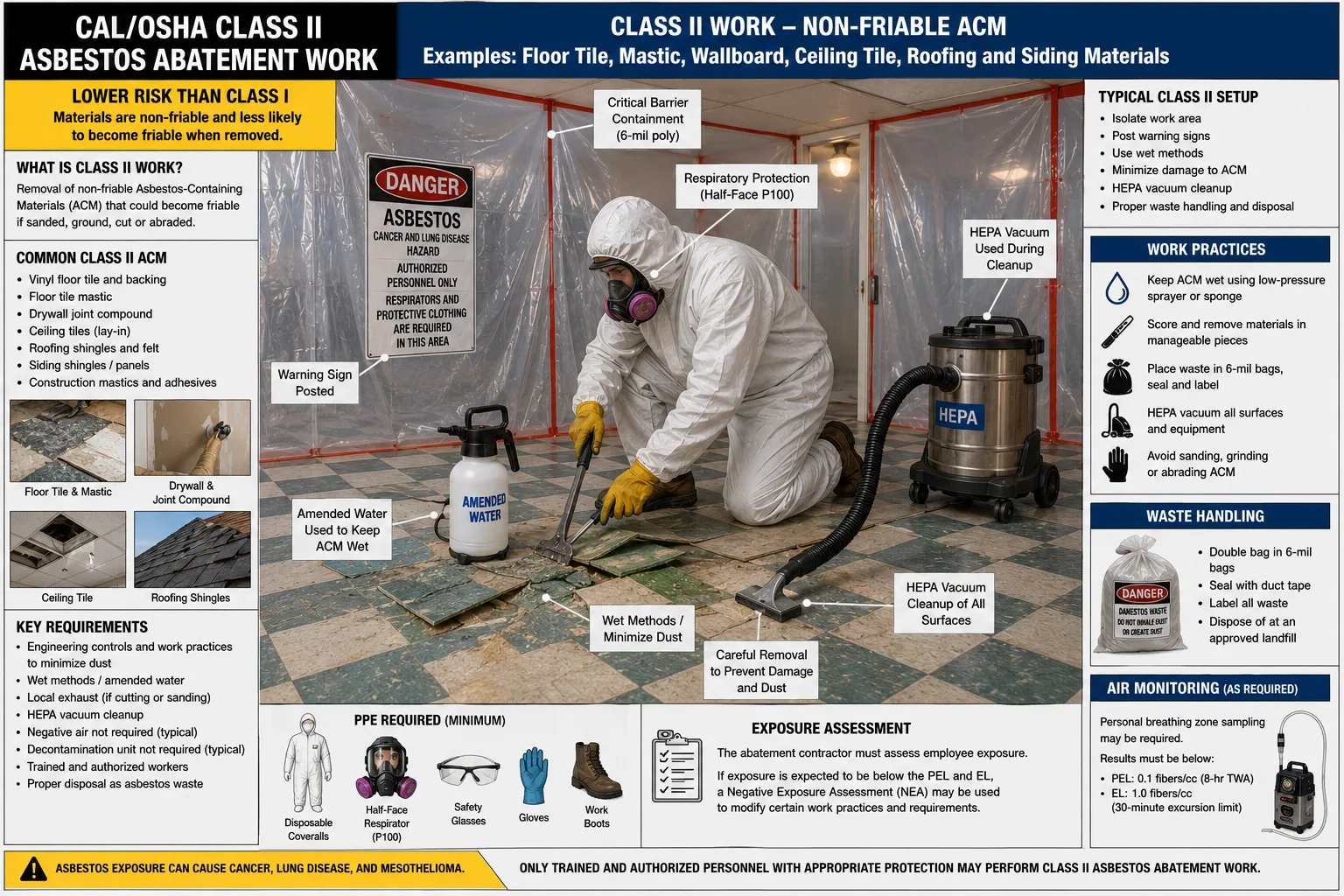
Class II means removal of ACM other than TSI or surfacing material. It is not automatically “lower risk” or limited to nonfriable material; intactness, indoor conditions, task and a valid exposure assessment affect containment, respiratory and hygiene controls.
Concept illustration · current signage, labels, PPE and controls govern.
Class II illustration: full size (opens in a new tab)
Class II: materials, controls and worker protection
- Material examples
- The poster includes vinyl floor tile and backing, flooring mastic, wallboard and joint compound, lay-in ceiling tiles, roofing shingles and felt, siding shingles or panels, and construction adhesives. Its inset photos compare flooring, wallboard, ceiling tile and roofing. Survey documentation determines asbestos content and classification.
- Central work scene
- A worker uses a hand tool on floor tile beside an amended-water sprayer and HEPA vacuum. The callouts emphasize controlled handling, wet methods and cleanup, with plastic barriers and warning signs around the example work area.
- Material condition
- The graphic contrasts intact material with material damaged by sanding, grinding or abrasion. Its nonfriable and lower-risk headings are simplified labels, not the Class II definition. Breaking or disturbing the material can change the controls needed.
- Work-area controls
- Isolation, access control, warnings, dust suppression and HEPA cleanup appear in the setup panel. Local exhaust, containment, negative air and decontamination depend on the operation; the poster's typical-setup exclusions are not blanket exemptions.
- Worker protection and training
- The equipment strip depicts coveralls, a half-face P100 respirator, safety glasses, gloves and work boots. The employer determines the applicable protection, hygiene and training. The image does not establish a universal minimum PPE package.
- Removal and cleanup practices
- The illustration shows low-pressure wetting or sponging, hand removal and HEPA cleaning of surfaces and equipment. Material-specific methods govern: do not treat the picture as permission to score, break, sand, grind or abrade every asbestos-containing product.
- Waste handling
- The waste panel illustrates double 6-mil bags, sealed seams, asbestos labeling and delivery to an appropriate facility. Actual packaging must account for sharp edges, size, material condition and facility acceptance requirements.
- Exposure assessment and monitoring
- The assessment panel discusses a valid negative exposure assessment and task-specific controls. The monitoring panel shows 0.1 fiber/cc as an eight-hour exposure limit and 1.0 fiber/cc over 30 minutes. Neither value is a universal clearance result.
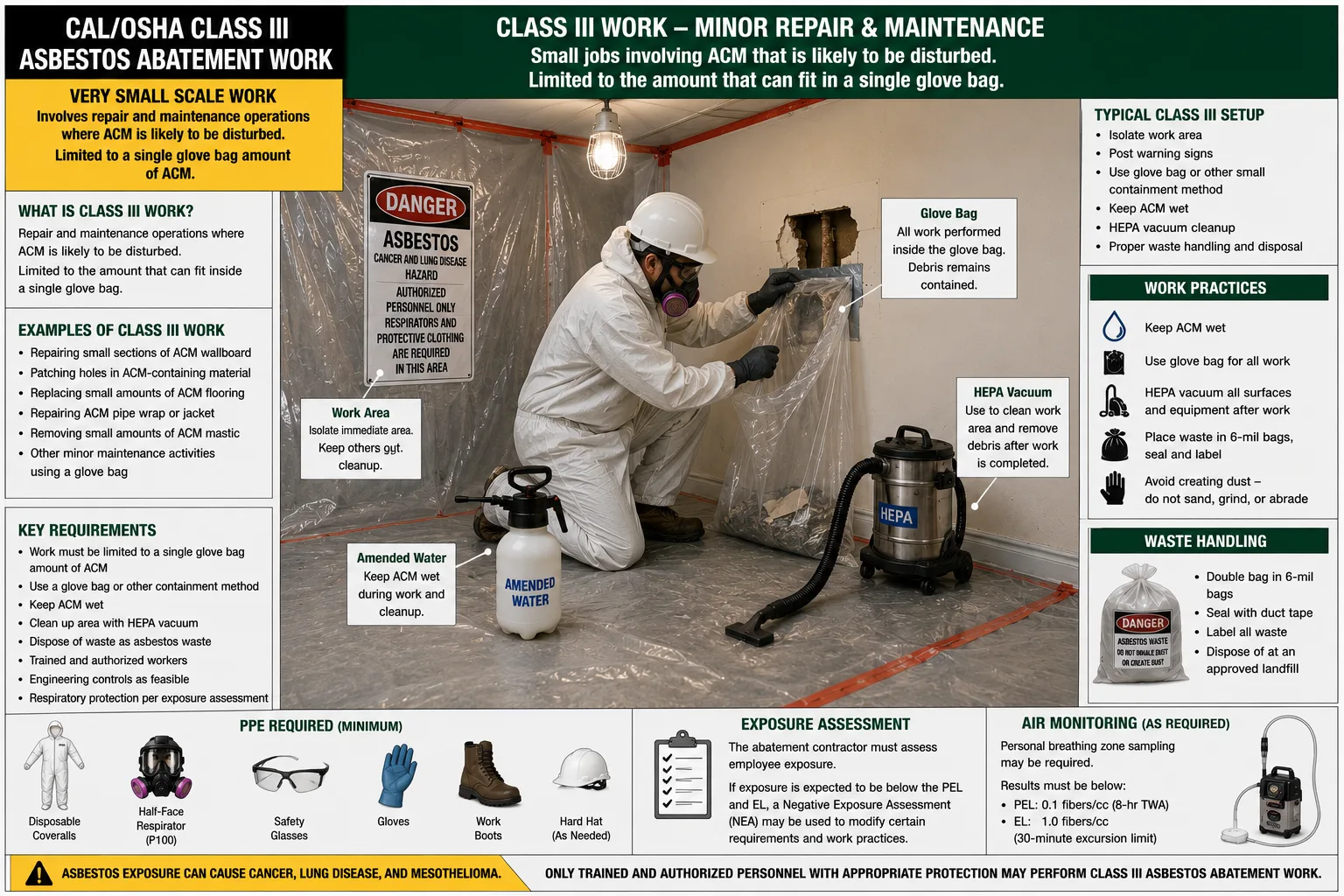
Class III is repair or maintenance likely to disturb ACM or PACM—not a rule that every job must fit one glovebag. Glovebags, mini-enclosures or another isolation method may apply depending on the material, disturbance and exposure assessment.
Concept illustration · current signage, labels, PPE and controls govern.
Class III illustration: full size (opens in a new tab)
Class III: materials, controls and worker protection
- Repair and maintenance examples
- The poster identifies small wallboard repairs, hole patching, flooring repairs, pipe-wrap or jacket repair, limited mastic work and glovebag maintenance. The task and regulatory disturbance limits determine whether a particular operation belongs in Class III.
- Central work scene
- A worker attends a wall access opening with localized containment, an amended-water bottle and a HEPA cleanup vacuum. The image focuses on controlling disturbance within an existing building, not unrestricted removal.
- Work area and access
- The callouts show isolation of the affected area, warning signs and keeping other people outside the work zone. The selected controls must also address adjacent spaces and the actual repair location.
- Glovebags and other isolation methods
- The small-job and glovebag panels illustrate one approach. They do not mean every Class III task uses one glovebag. The activity, amount disturbed, material and exposure assessment determine the applicable glovebag, mini-enclosure or other controls.
- Wet methods and HEPA cleanup
- The work-practice panels emphasize controlled wetting, collection of debris and HEPA cleaning of surfaces, equipment and the work area. Avoiding dust-producing sanding, grinding and abrasion remains a prominent message.
- Worker protection and training
- The equipment strip shows disposable coveralls, a half-face P100 respirator, safety glasses, gloves, work boots and a hard hat as needed. Applicable respiratory protection, hygiene, training and authorization follow the task, not a fixed illustrated kit.
- Waste handling
- The poster shows 6-mil bag packaging, sealing, labeling and appropriate disposal of asbestos debris. Packaging must remain suitable for the waste and transport conditions; the picture is not a universal disposal specification.
- Exposure assessment and monitoring
- The employer-assessment panel addresses the work conditions and any valid negative exposure assessment. The displayed occupational exposure limits are 0.1 fiber/cc over eight hours and 1.0 fiber/cc over 30 minutes, distinct from project-specific release criteria.
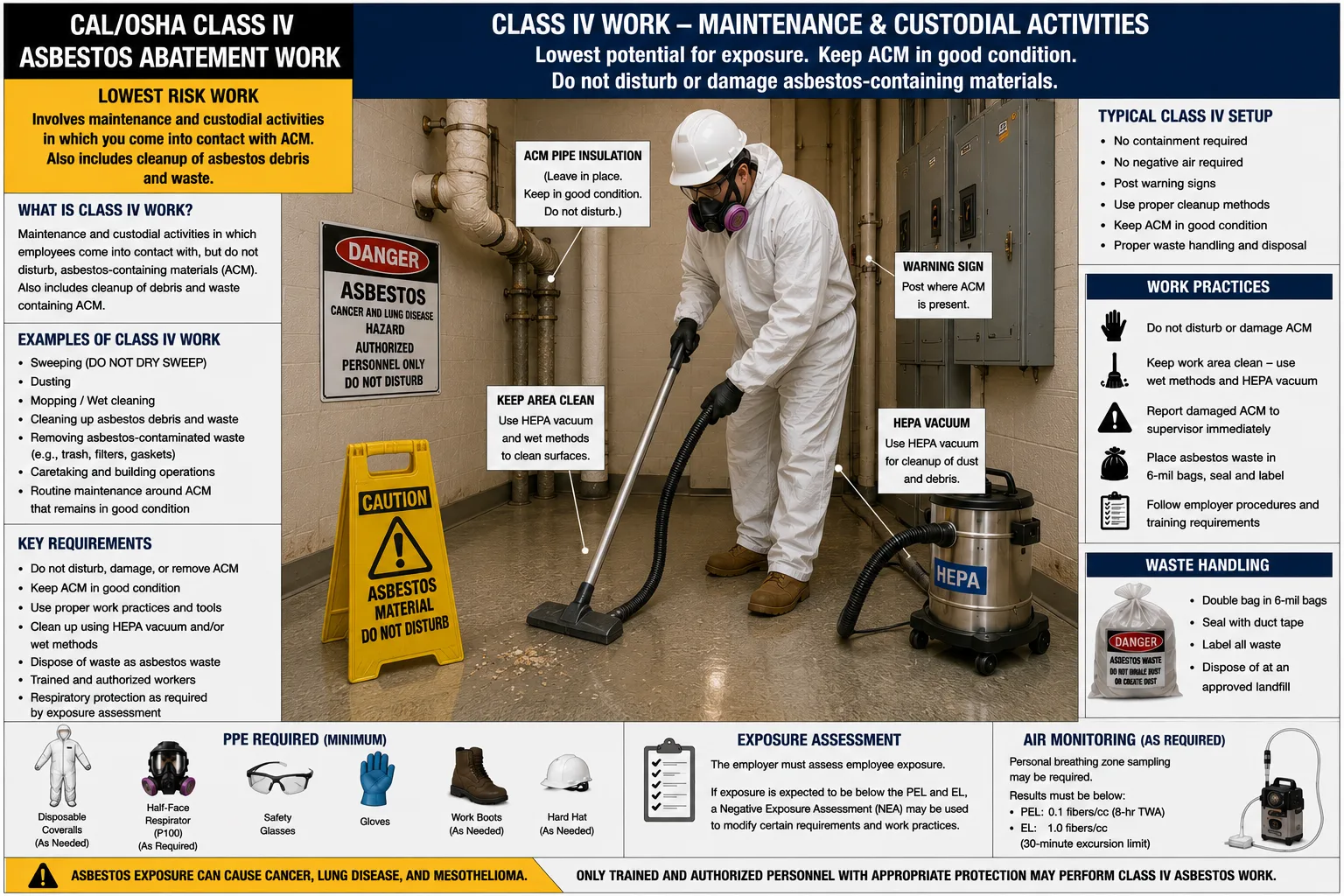
Class IV covers contact without disturbance and cleanup of certain dust, waste or debris. “No containment” and “no negative air” are not universal promises; inside a higher-class regulated area, applicable higher-class hygiene and respiratory requirements follow.
Concept illustration · current signage, labels, PPE and controls govern.
Class IV illustration: full size (opens in a new tab)
Class IV: materials, controls and worker protection
- Maintenance and custodial context
- The poster shows contact without disturbing installed ACM, plus cleanup of asbestos dust, waste or debris from other work. Caretaking and routine building operations around intact material are different from repair or removal that disturbs it.
- Activity and waste examples
- The examples include wet mopping and cleaning, dust or debris cleanup, and handling contaminated trash, filters or gaskets. Sweeping and dusting references are not permission for dry cleanup: the poster expressly warns against dry sweeping.
- Central work scene
- A worker uses a HEPA vacuum near intact pipe insulation in a utility room. The callouts identify the insulation to leave undisturbed, warning signs, controlled access, clean surfaces and the HEPA cleanup equipment.
- Material condition and work-area controls
- Keep intact ACM from being damaged and report changed or damaged material to the supervisor. The no-containment and no-negative-air statements shown in the image are not universal exclusions, particularly inside another crew's regulated work area.
- Cleanup practices
- The work-practice panels emphasize wet methods, HEPA vacuuming, proper tools and avoiding disturbance of installed ACM. Follow the employer's procedures for collecting contaminated dust and debris without spreading it into adjacent areas.
- Worker protection and training
- The PPE strip depicts coveralls, a half-face P100 respirator, glasses, gloves, work boots and head protection, with several items marked as needed or required. Training, respiratory protection and hygiene depend on the task and work area, including applicable higher-class work requirements.
- Waste packaging and disposal
- The example shows 6-mil bags, double-bagging, taped seals, asbestos labels and appropriate disposal. Use packaging appropriate for the actual waste, handling and receiving-facility requirements; do not use an ordinary waste stream for asbestos debris.
- Exposure assessment and monitoring
- The poster includes employer exposure assessment, possible personal sampling and a valid negative exposure assessment where applicable. It shows occupational limits of 0.1 fiber/cc over eight hours and 1.0 fiber/cc over 30 minutes, not a promise that the illustrated task has a particular exposure level.
Employer responsibility: The performing employer determines the applicable work class and must provide the required competent-person supervision, exposure assessment and control selection for the survey, material, planned task and site conditions. The class alone does not establish a universal respirator, PPE kit, containment, decontamination, monitoring, clearance, waste package, license or registration requirement.
Project Sequence
From Survey to Downstream Construction
The exact parties and requirements change by project. The sequence below keeps the responsibility handoffs visible.
- 01
Define the Work
Identify what will be demolished, renovated, opened, excavated, or disturbed.
- 02
Complete the Survey
Use an appropriate independent survey that matches the affected scope.
- 03
Resolve Gaps
Clarify layers, quantities, access, occupancy, waste, notices, and release criteria.
- 04
Assign Responsibilities
State who prices, submits, performs, monitors, transports, signs, and closes each item.
- 05
Complete Prerequisites
Address assigned notices, approvals, access, facility acceptance, and scheduling.
- 06
Authorized Removal
The appropriately authorized asbestos contractor performs its project-specific scope.
- 07
Verify and Close
Assigned parties issue their monitoring, clearance, waste, and closeout records when required.
- 08
Release Downstream Work
Demolition or renovation proceeds after the required documentation and release conditions are satisfied.
No permit, notification acceptance, inspection, clearance result, or other third-party outcome is guaranteed.
Changed Conditions
When the Field Condition Changes
Concealed layers, damaged materials, or quantity increases can change work methods, notifications, waste acceptance, price, access, and schedule. Preserve the facts and written change process before proceeding.
- Pause and stabilize
Stop the affected activity without causing additional disturbance.
- Document the condition
Record location, apparent extent, condition, photographs, and work already performed.
- Notify assigned parties
Inform the owner, contractor, consultant, and other responsible project parties.
- Obtain independent evaluation
Update the survey or project documents when required.
- Reconcile the impacts
Review quantities, notices, work plan, waste profile, access, schedule, and cost.
- Authorize before resuming
Preserve change-order and delay rights, then proceed only with required direction and written authorization.
Waste and Records
Closeout Starts With Assigned Responsibilities
Material type, condition, quantity, jurisdiction, facility rules, and project specifications affect waste and record requirements. The written proposal should state who prepares, signs, submits, tracks, and delivers each record.
- Waste characterization and receiving-facility profile approval.
- Packaging, labeling, staging, loading, and quantity controls.
- Generator information and required owner or generator signatures.
- Transporter qualifications and applicable shipping documents.
- Receiving-facility acceptance and disposal records.
- Daily records, photographs, quantities, and closeout delivery.
- Assigned consultant, laboratory, notification, monitoring, and clearance records.
Common Questions
Asbestos Planning Questions
These answers explain the scope and responsibility issues that commonly affect demolition and renovation planning.
Can asbestos be identified by appearance or building age?
No. Appearance and construction date alone do not establish whether a material contains asbestos. The planned scope and an appropriate independent survey control the decision.
Is a survey needed before demolition or renovation?
Within South Coast AQMD jurisdiction, Rule 1403 generally requires a prior asbestos survey of the facility components affected by demolition or renovation, subject to the rule's project-specific provisions. Full demolition requires a broader survey than a limited renovation. Projects outside that jurisdiction must be reviewed under the applicable air-district and other requirements.
Does SoCal Removal perform asbestos surveys, sampling, monitoring, or clearance?
No. Those are independent professional or laboratory functions performed by appropriately qualified parties when required.
Does SoCal Removal self-perform asbestos removal?
No. All asbestos removal, whatever the size, is subcontracted to an appropriately licensed asbestos abatement contractor registered with Cal/OSHA. CSLB #980451 lists ASB — Asbestos for bidding purposes only.
Does a 100-square-foot threshold mean smaller work is unregulated?
No. Different thresholds apply to different registration, notification, work-practice, worker-protection, survey, waste, and recordkeeping requirements. A single quantity threshold should not be used to decide that no asbestos requirement applies.
How long does asbestos-related project planning take?
Timing depends on survey completeness, consultant availability, quantities, occupancy, access, contractor procurement, required notices, written approvals, waste acceptance, monitoring or clearance requirements, and downstream construction sequencing. In South Coast AQMD jurisdiction, a 10-working-day notification period applies to many covered demolition and renovation activities, but the exact requirement must be confirmed for the project.
What if additional material is found after work starts?
Pause the affected activity, document the condition, obtain independent evaluation, and determine whether the survey, notification, contractor scope, waste profile, price, or schedule must be revised before work resumes.
What should I submit for project review?
Send the complete current survey and laboratory attachments, plans or marked-up scope, specifications, photographs, project address, occupancy and access information, desired schedule, public/private and prevailing-wage status, insurance and bonding requirements, and the demolition or renovation work that follows.
Document-First Review
Start With the Current Documents
Provide the survey, project scope, and schedule information currently available. We will identify missing inputs, responsibility interfaces, and the next practical step for the demolition or renovation package.
Orange County Asbestos Project Experience
Our project history includes garage ADU wall removal in Laguna Beach, ceiling drywall removal in Tustin, flooring removal in Santa Ana and bathroom-renovation abatement at Crystal Cove Care Center in Newport Beach. Each assignment has its own surveyed materials, removal limits and construction sequence.
- Asbestos Sheet Flooring Removal in Santa Ana — Residential Property
- Garage ADU Asbestos Wall Removal in Laguna Beach — Residential Property
- Asbestos Ceiling Drywall Removal in Tustin — Residential Property
- Bathroom Renovation Abatement at Crystal Cove Care Center — Care Facility
Los Angeles County Asbestos Project Experience
Explore asbestos-related ceiling removal, fire-damaged property cleanup and dental-office renovation scopes in Los Angeles County.
- Asbestos Popcorn Ceiling Removal in Compton — Residential Property
- Fire-Damaged Property Abatement and Cleanup in Boyle Heights — Fire-Damaged Property
- Dental Office Demolition and Abatement in Redondo Beach — Dental Office
Cities we serve
Asbestos abatement before demolition and renovation, performed by our Cal/OSHA-registered subcontractor, in:
Anaheim · Costa Mesa · Dana Point · Huntington Beach · Irvine · Laguna Beach · Mission Viejo · Newport Beach · Orange · San Clemente · Santa Ana · Tustin · Long Beach · Beverly Hills
Related projects: Huntington Beach townhome asbestos ceiling removal · Costa Mesa acoustic ceiling removal · Newport Beach Peninsula pre-demolition asbestos removal
Pricing: popcorn ceiling removal cost
Terms used on this page are defined in the asbestos, lead and Cal/OSHA glossary.