Santa Ana-based contractor · CSLB #980451 · License, insurance and bonding
Mission Viejo Demolition, Abatement & Site Preparation
SoCal Removal works in Mission Viejo on homes, retail buildings and community facilities. We have demolished and cleared a former retail building after its asbestos abatement by a registered subcontractor, removed a concrete dam beneath a cart bridge at Mission Viejo Country Club, and worked on a residential Procedure 5 asbestos cleanup.
Get a Quote Call (949) 446-0000
Our work in Mission Viejo
Mission Viejo projects we have completed:
- Former rug shop abatement and building demolition — interior and rooftop abatement, masonry building demolition and site clearing
- Mission Viejo Country Club concrete dam removal — concrete removed beneath and around a steel cart bridge that stayed in place
- Residential Procedure 5 asbestos cleanup — about 130 square feet, with containment and decisions on what contents to save
 Former Rug Shop Abatement and Building Demolition in Mission Viejo
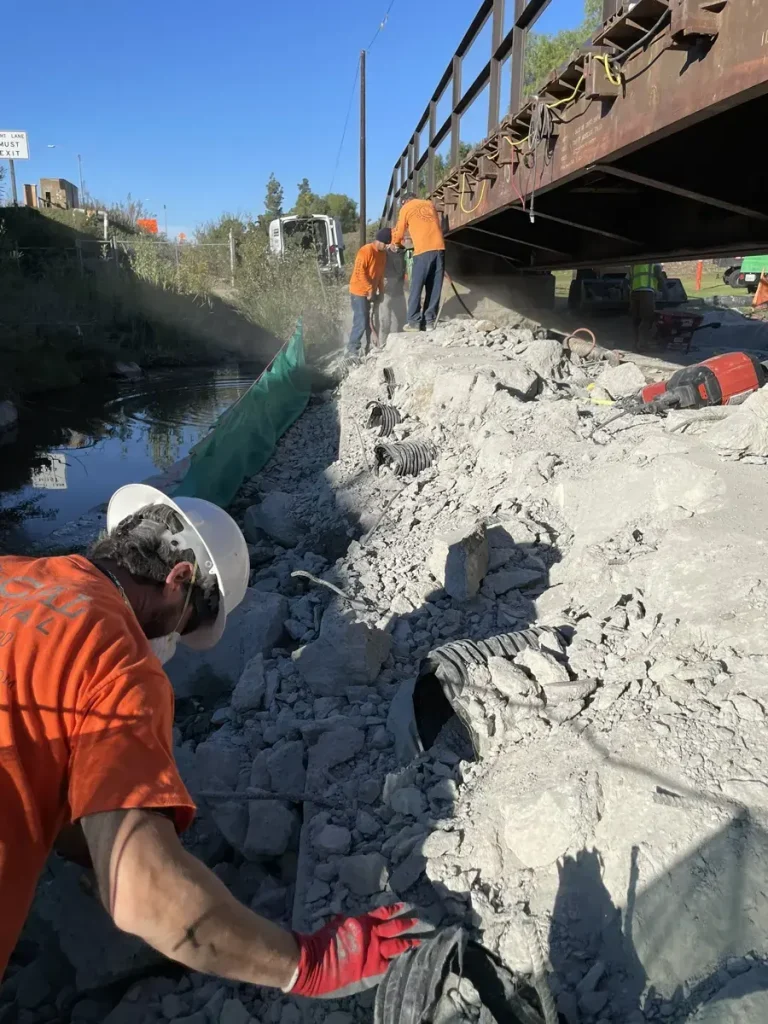 Concrete Dam Removal at Mission Viejo Country Club
 Procedure 5 Asbestos Cleanup at a Mission Viejo Residence
 Block building during equipment demolition
 Selective concrete breaking near the bridge
 Building removal and debris handling
Demolition in Mission Viejo
Most Mission Viejo homes date from the 1970s and 1980s, so our work here is mostly remodel strip-outs, garages and accessory structures, and the occasional full tear-down, plus retail and community buildings. On sites like the country club, the job is removing one feature while protecting what stays.
- Building demolition: retail buildings, homes, garages and accessory structures
- Selective demolition: concrete features, walls and openings next to structures that stay
- Interior demolition: kitchen, bath and whole-house strip-outs
- Exterior demolition: patios, block walls and pool decks
- Pool removal: partial or full removal, utilities capped, backfill compacted in lifts
- Demolition and site clearing: structures, slabs and paving out, lots cleared and fenced
Our crews work daylight hours, inside Mission Viejo’s allowed construction hours. When a store, office, campus or care facility needs to stay open, we offer after-hours and phased work where the city allows it.
What a demolition permit in Mission Viejo requires
Permits are issued by Building Services at 200 Civic Center, and everything is submitted through the city’s online portal (Building Services). The city’s building forms include an AQMD form, a Neighbor Awareness Form and a pool and spa demolition form (city document center).
Mission Viejo requires 75% of construction and demolition debris to be diverted on covered projects, meaning construction, renovation, additions or demolition of 250 square feet or more and $10,000 or more in valuation, including reroofs with tear-off; a good-faith effort that falls short can still earn a partial refund of up to 75% of the deposit (MVMC 6.10.1105 and 6.10.1135; city C&D program). You can use city-provided construction bins or self-haul to Waste Management or a C&D recycler, with a diversion plan and final report for the self-haul option. Waste Management holds the city’s exclusive franchise, and the C&D form is also required for pool, repipe, reroof and HVAC permits (city portal guide). Deposit refunds must be requested within six months of final inspection (city FAQ).
Permit rules on this page were checked against city sources in October 2026 and are re-checked every six months.
Water districts and utilities in Mission Viejo
Mission Viejo is split among four water districts: El Toro, Moulton Niguel, Santa Margarita and Trabuco Canyon. Power comes from SDG&E or SCE depending on the address, and gas from SoCalGas (city utility providers). Santa Margarita and Moulton Niguel also provide sewer in their areas, so the disconnect letters depend on where the property sits. We confirm the providers for the parcel before we request shutoffs.
Site preparation in Mission Viejo
After demolition we remove slabs, footings and flatwork, clear the lot and rough grade it, and recycle concrete and asphalt.
- Pool removal. A demolition permit is required before any work, and a homeowner, a general contractor, a pool contractor or a C-21 demolition contractor may pull it; SoCal Removal holds both B and C-21. Every pool job needs a plot plan with setbacks, decking and bond beam removed to 12 inches below grade, and electrical conduit and gas lines removed and capped at the source. Option A, with no soils engineer, leaves the shell, removes the top 24 inches of wall, drills two 3-by-3-foot holes in the lowest part of the bottom and fills with crushed rock to within 18 inches of grade under filter cloth and topsoil, but no future structure is allowed over it. Option B, for future construction, breaks out or removes the bottom, places 6 inches of ¾-inch gravel, compacts soil in 12-inch lifts and requires a soils engineer’s report showing at least 90% compaction. The city inspects the bottom holes and bond beam removal, the utility disconnects and the final grade (pool and spa demolition standards). The C&D diversion form is also required.
- Cal/OSHA on pool removals. When the pool shell comes out and the hole is 5 feet or deeper, it is an excavation under Cal/OSHA, and the contractor needs a Cal/OSHA Trench/Excavation permit, permit type T1 on the Cal/OSHA application, before anyone goes in (8 CCR 341, Cal/OSHA form 41-1). We pull a T1 project permit for the job and designate a competent person for each project, as the permit requires. Excavations 5 feet or deeper must be sloped, benched or shored unless they are entirely in stable rock (8 CCR 1541.1), and a competent person inspects the excavation daily and after every rain. We keep broken concrete and spoil at least 2 feet from the edge, provide a ladder or ramp within 25 feet of travel, barricade the open pit and keep crews out of standing water (8 CCR 1541), and we call DigAlert at least two working days before digging (CSLB). Breaking the shell with jackhammers falls under Cal/OSHA’s silica standard, so we use water at the point of impact or shrouded dust collection under a written exposure control plan (8 CCR 1532.3).
- Grading. Any grading, clearing, brushing or grubbing needs a grading permit, as do paving over 3,000 square feet and stockpiling, while pool and spa demolition is exempt (MVMC 8.10.300–8.10.340). The rainy season runs October 1 to April 30: grading over 200 cubic yards then needs an approved erosion-control system, erosion plans are due September 1, and protective devices go in at the end of each day when the five-day rain chance tops 40%. Public Works Engineering issues grading permits and inspects grading and haul routes (Public Works). Plan check fees start at 1 to 500 cubic yards, and the grading bond is figured from yardage plus erosion-control costs (fee schedule).
- Hours. Construction is allowed 7 a.m. to 8 p.m. Monday through Saturday, with none on Sundays or federal holidays (MVMC 6.35.060).
- Bins and stockpiles in the street. Construction bins in the street need an encroachment permit, issued only to city-permitted haulers, with a $5,000 performance deposit, up to 30 days per permit, $1 million in liability coverage, reflectors and the permit posted on the bin (MVMC 14.10). Storage in the street runs $220 per week, and a storage container or stockpile may stay on a residential street for no more than 168 hours. Haul routes and oversize loads need their own permits (same fee schedule).
On every Mission Viejo site we control dust under South Coast AQMD Rule 403: water on the work, no visible dust past the property line and track-out cleaned up daily. More on site preparation, concrete removal, grading and utility locating.
Abatement in Mission Viejo
Abatement means removing what makes a property unsafe, unpermitted or unusable. Owners usually call us after a city notice of violation, before a sale, or before a rebuild.
- Unpermitted additions and structures: enclosed patios, garage conversions, sheds and rooms built without permits, removed under a demolition permit so the property matches its approved plans again.
- Damaged and unsafe buildings: fire-, storm- or impact-damaged structures secured with board-up and fencing, then taken down.
- Rubbish and abandoned items: junk, debris piles, old appliances and leftover building materials loaded, hauled and recycled.
- Hazardous substances: under our CSLB HAZ certification we remove contaminated soil and abandoned fuel and holding tanks.
- Brush and old pools: weeds and brush cut for fire clearance, and unused pools removed by the method the city requires.
See hauling and disposal, land clearing and hazardous materials prices.
Asbestos abatement before demolition in Mission Viejo
About 52.3% of Mission Viejo homes were built before 1980, most of them in the 1970s (SCAG housing data). Our Mission Viejo work includes a residential Procedure 5 asbestos cleanup and the interior and rooftop abatement of a former retail building before its demolition.
In 1970s Mission Viejo homes the abatement work most often covers popcorn ceilings, drywall joint compound, floor tile and mastic, and HVAC duct and furnace-closet materials. In older retail buildings, roofing and interior finishes are common.
Every job starts with a survey by an independent Certified Asbestos Consultant and accredited-lab results. You can hire the consultant directly, or we bring one in and include the fee in our estimate. When the survey finds asbestos, a separately licensed asbestos abatement contractor registered with Cal/OSHA (DOSH) removes it under subcontract to SoCal Removal, following Cal/OSHA’s asbestos standard (8 CCR 1529) and South Coast AQMD Rule 1403: the work area contained, the material kept wet, and the waste bagged, labeled and hauled under a manifest. An independent consultant can run clearance air samples before the area is reopened, and we schedule the demolition around that work.

Every demolition in the South Coast air district, including Mission Viejo, needs the asbestos survey and an AQMD notification 10 working days before work starts, even when no asbestos is found (Rule 1403). For lead, SoCal Removal is an EPA RRP lead-certified firm and removes lead-based paint, lead-glazed tile and coated components as part of renovation and demolition, using lead-safe work practices. When a project calls for lead abatement under California rules, that work is done by certified lead workers with the required controls, notifications and medical monitoring; our pollution coverage is listed on our qualifications page. See asbestos abatement, lead removal and testing prices.
Disaster recovery in Mission Viejo
State fire maps recommend 825 acres of Mission Viejo as Very High fire hazard (OSFM 2025 maps). During the October 2020 Silverado Fire, an evacuation warning covered the area bounded by El Toro Road, Marguerite Parkway, Upper Oso Reservoir and Los Alisos Boulevard (ABC7). The city’s draft hazard mitigation plan also lists inundation risk below Upper Oso Reservoir, El Toro Reservoir and Lake Mission Viejo, liquefaction in parts of the city and landslide potential in the east. It records the January 1997 windstorm that brought down more than 1,000 trees and the January 2023 windstorm that cut power to more than 25,000 customers (draft hazard mitigation plan).
After a fire, flood, earthquake or vehicle impact, we secure the property first with board-up and temporary fencing. Then we remove damaged materials and debris and, once the owner, insurer and city agree on the scope, demolish what can’t be saved and clear the site for the rebuild. Our nearby recovery work includes fire-debris cleanup after the Tustin hangar fire and fire-damaged property cleanup and pool removal in Anaheim.
After a disaster, inspectors may post a green Inspected, yellow Restricted Use or red Unsafe placard; only the building department can remove one, and a red placard is not a demolition order (Cal OES). Damaged asbestos is a common problem after a fire, a broken pipe or a tree through the roof. South Coast AQMD requires an approved Procedure 5 plan before damaged asbestos material is cleaned up, which is the procedure followed on our Mission Viejo residential cleanup. When a government agency orders a dangerous building demolished, the notice is filed as an ordered demolition without the usual 10-working-day wait (AQMD Rule 1403 FAQ). State guidance treats ash and burned debris as potentially hazardous, so we keep loads damp or covered and haul them to permitted landfills (DTSC wildfire guidance). Homeowner policies often include debris-removal coverage on top of the dwelling limit, commonly an extra 5% of Coverage A, so ask your adjuster (California Department of Insurance).
What it costs in Mission Viejo
Our published 2026 prices are the same in Mission Viejo as everywhere else we work. City permit fees, the AQMD notification fee and any recycling deposit are extra; see demolition permit and AQMD fees by city.
- House, garage or ADU demolition, collapse and remove with the slab left: $26.50–$31.50 per square foot
- Full demolition to dirt, foundation and slab out: $42–$51 per square foot
- Fire-damaged structure demolition, slab left: $29–$35 per square foot
- Interior demolition and gut-outs: $22.50–$26.50 per square foot
- In-ground pool removal, by the method the city requires: $15,750–$31,500
- Concrete slab removal, 4 inches: $8.75–$10.50 per square foot ($6–$7.25 at 5,000 SF and up)
- Lot clearing and grubbing: $22,000–$26,250 per acre
- Rough grading: $1.35–$1.85 per square foot of pad
- Asbestos popcorn ceiling abatement, by our registered subcontractor: $9.50–$12.75 per square foot
- Asbestos floor tile and mastic abatement, by our registered subcontractor: $17–$23.50 per square foot
- Asbestos sample, standard turnaround: $120–$145 per sample
- Temporary 6-foot construction fence: $21–$25 per linear foot
Minimums are $3,750 for demolition and site preparation and $1,950 for asbestos or lead work. See the demolition, fire-damaged demolition, interior demolition, asbestos removal, popcorn ceiling, pool removal, land clearing and grading cost guides, or all 2026 prices.
Mission Viejo demolition and abatement questions
How much demolition debris has to be recycled in Mission Viejo?
75% on covered projects. You can use city-provided construction bins or self-haul to Waste Management or a C&D recycler, and the deposit refund must be requested within six months of final inspection.
Can I build over a filled pool in Mission Viejo?
Only with Option B: the bottom broken out or removed, gravel and compacted soil in 12-inch lifts, and a soils engineer’s report showing at least 90% compaction. Option A, which leaves the shell, allows no future structure.
How long can a dumpster stay on a Mission Viejo street?
No more than 168 hours, or one week, on a residential street, with an encroachment permit at $220 per week.
What hours can demolition run in Mission Viejo?
Construction is allowed from 7 a.m. to 8 p.m. Monday through Saturday, with no work on Sundays or federal holidays. Our crews work daylight hours and offer after-hours work where the city allows it.
What is a Procedure 5 asbestos cleanup?
It is the South Coast AQMD-approved plan required before damaged asbestos material is cleaned up, for example after a fire or a leak. Our registered abatement subcontractor followed one on a Mission Viejo home with about 130 square feet of cleanup.
Which water district handles my Mission Viejo disconnect?
It depends on the address: El Toro, Moulton Niguel, Santa Margarita or Trabuco Canyon. Santa Margarita and Moulton Niguel also handle sewer in their areas. We confirm it for your parcel.
Start with the address and a few photos
Send the property address, photos, any asbestos survey and your target schedule. We walk the site, check the permit path for that parcel and send a written, itemized price. Call (949) 446-0000 or request a project review.
Nearby: Irvine · Laguna Beach · San Clemente · All of Orange County