Santa Ana-based contractor · CSLB #980451 · License, insurance and bonding
Huntington Beach Demolition, Abatement & Site Preparation
SoCal Removal handles house and commercial demolition, abatement and site preparation in Huntington Beach: unpermitted additions torn out, damaged and unsafe structures taken down, rubbish hauled away and the lot made ready to build. When asbestos turns up before demolition, a Cal/OSHA-registered abatement subcontractor removes it. The city has a long oil-field history, most of its housing predates 1980 and parts of it are in the coastal zone, so we check for wells, asbestos and coastal permit needs before we price the work.
Get a Quote Call (949) 446-0000
Our work in Huntington Beach
Recent Huntington Beach work:
- Townhome asbestos acoustic ceiling removal — protected interior access and a defined abatement stage before ceiling updates
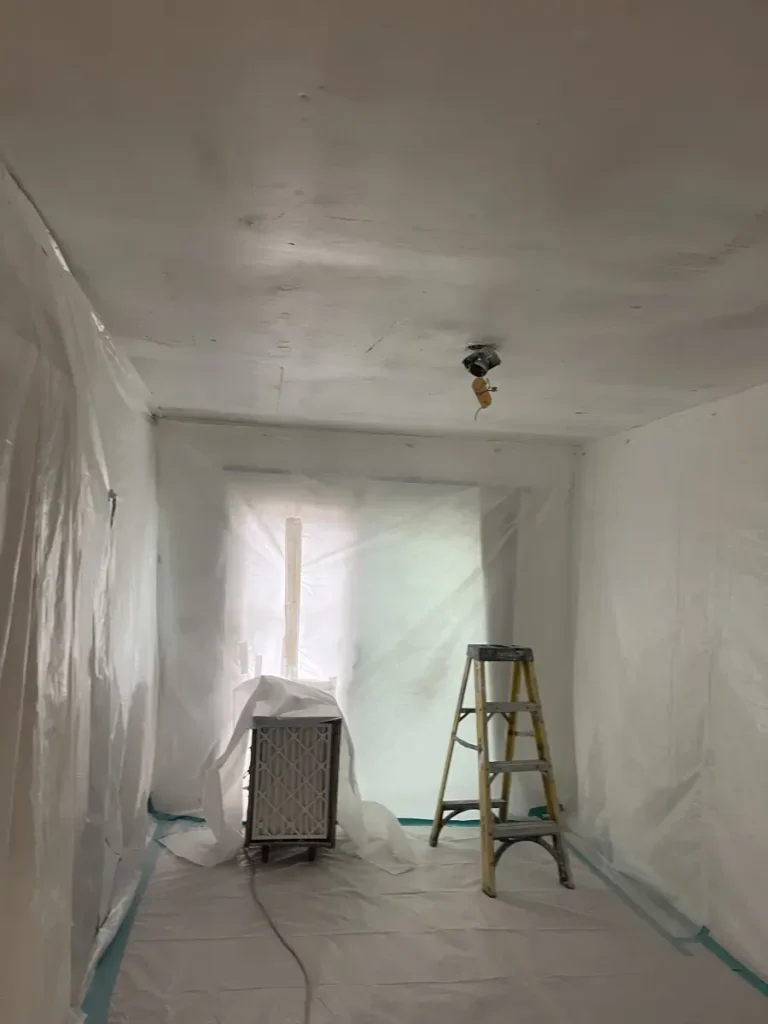 Townhome Asbestos Acoustic Ceiling Removal in Huntington Beach
 Temporary enclosure at the townhome access area
 Protected stair route within the townhome
Demolition in Huntington Beach
Most of our Huntington Beach demolition is a house, garage or ADU coming down for a rebuild, or a townhome or storefront being stripped for a remodel. On a tear-down we collapse and remove the structure, and if your builder wants a clean pad we break out the foundation and slab so the lot goes to dirt. Demolitions over 10,000 square feet also need Public Works approval.
- House and building demolition: houses, garages, ADUs and commercial buildings, slab left or to dirt
- Interior demolition: townhome, condo and tenant-improvement strip-outs
- Selective demolition: walls, kitchens, baths and new openings when the rest of the building stays
- Exterior demolition: patios, block walls, carports and facades
- Pool removal: partial or full removal, utilities capped, backfill compacted in lifts
- Demolition and site clearing: structures, slabs and paving out, lots cleared and fenced
Our crews work daylight hours, inside Huntington Beach’s allowed construction hours. When a store, office, campus or care facility needs to stay open, we offer after-hours and phased work where the city allows it.
What a demolition permit in Huntington Beach requires
Demolition permits are issued by Building & Inspections in the Community Development Department at 2000 Main Street, with plans submitted online. The city’s demolition guidelines require:
- A site plan showing existing square footage, setbacks, capping of all utilities and the demolition method
- A construction and demolition debris recycling form
- A Permit & Asbestos Disclosure form; the city states AQMD notification is always required when load-bearing members are demolished
- NPDES general notes for storm water protection
- A Hold Harmless agreement if plans for the new building are not yet approved
- Public Works approval for demolitions over 10,000 square feet
Huntington Beach requires at least 65% of debris to be recycled and 100% of asphalt, concrete and dirt. The recycling plan must be approved before the permit is issued, and the waste log and weight tickets are kept in Green Halo (city C&D worksheet). Rented debris bins must come from Republic Services, the city’s authorized hauler, and bins from other companies are cited; a contractor may still haul mixed debris in its own trucks to a city-approved facility (city hauler notice).
Plans go through the city’s HB ACA online portal, and construction work hours are 7 a.m. to 7 p.m., Monday through Saturday.
Permit rules on this page were checked against city sources in October 2026 and are re-checked every six months.
Oil wells and coastal permits in Huntington Beach
The city will not issue a building or grading permit on a parcel with an active or abandoned oil well until the Fire Code Official approves it under City Specification 422 (HBMC 15.32.090). If you are demolishing to rebuild, check for wells early: the state’s free CalGEM Construction Site Well Review takes 6 to 8 weeks, and any re-abandonment is at the owner’s cost.
In the coastal zone, the city code counts demolition as development, so a coastal development permit is needed unless the project is exempt or excluded. The city issues those permits under its certified Local Coastal Program (HBMC Chapter 245).
The city’s Utilities Division provides water and sewer, Southern California Edison provides power and SoCalGas provides gas.
Site preparation in Huntington Beach
After demolition we remove footings, slabs, flatwork and block walls, clear the lot and rough grade it to your plans. Concrete and asphalt go to recyclers and clean soil is reused or exported, which keeps the job inside the city’s 100% recycling rule for those materials.
- Pool removal. The city requires a demolition permit to remove a pool. Its guidelines call for holes in the bottom, the bond beam and decking removed to 12 inches below grade, 6 inches of gravel, backfill in 12-inch lifts, a soils engineer’s preliminary report, a compaction report showing at least 90% and three inspections (pool demolition guidelines).
- Cal/OSHA on pool removals. When the pool shell comes out and the hole is 5 feet or deeper, it is an excavation under Cal/OSHA, and the contractor needs a Cal/OSHA Trench/Excavation permit, permit type T1 on the Cal/OSHA application, before anyone goes in (8 CCR 341, Cal/OSHA form 41-1). We pull a T1 project permit for the job and designate a competent person for each project, as the permit requires. Excavations 5 feet or deeper must be sloped, benched or shored unless they are entirely in stable rock (8 CCR 1541.1), and a competent person inspects the excavation daily and after every rain. We keep broken concrete and spoil at least 2 feet from the edge, provide a ladder or ramp within 25 feet of travel, barricade the open pit and keep crews out of standing water (8 CCR 1541), and we call DigAlert at least two working days before digging (CSLB). Breaking the shell with jackhammers falls under Cal/OSHA’s silica standard, so we use water at the point of impact or shrouded dust collection under a written exposure control plan (8 CCR 1532.3).
- Grading. A grading permit is needed for anything beyond minor work of about 50 cubic yards of shallow cut or fill (HBMC 17.05). From October 1 to April 30, grading over 200 cubic yards needs an approved erosion-control system.
- Bins and hauling. A city permit is required to place a storage container, materials or any obstruction in the street (HBMC 12.13.040). Hauling under the city’s haul route permit runs weekdays from 7 a.m. to 5 p.m., with tarps, a water truck and shaker plates, and stops during and after rain (haul route application).
On every Huntington Beach site we control dust under South Coast AQMD Rule 403: water on the work, no visible dust past the property line and track-out cleaned up daily. More on site preparation, concrete removal, grading and utility locating.
Abatement in Huntington Beach
Abatement means removing what makes a property unsafe, unpermitted or unusable. Owners usually call us after a city notice of violation, before a sale, or before a rebuild.
- Unpermitted additions and structures: enclosed patios, garage conversions, sheds and rooms built without permits, removed under a demolition permit so the property matches its approved plans again.
- Damaged and unsafe buildings: fire-, storm- or impact-damaged structures secured with board-up and fencing, then taken down.
- Rubbish and abandoned items: junk, debris piles, old appliances and leftover building materials loaded, hauled and recycled.
- Hazardous substances: under our CSLB HAZ certification we remove contaminated soil and abandoned fuel and holding tanks.
- Brush and old pools: weeds and brush cut for fire clearance, and unused pools removed by the method the city requires.
See hauling and disposal, land clearing and hazardous materials prices.
Asbestos abatement before demolition in Huntington Beach
About 73.5% of Huntington Beach homes were built in 1979 or earlier (SCAG housing data), so acoustic ceilings, floor tile and joint compound with asbestos are common. Our Huntington Beach work includes asbestos acoustic ceiling removal in an occupied townhome, with protected access through the rest of the unit.
Every job starts with a survey by an independent Certified Asbestos Consultant and accredited-lab results. You can hire the consultant directly, or we bring one in and include the fee in our estimate. When the survey finds asbestos, a separately licensed asbestos abatement contractor registered with Cal/OSHA (DOSH) removes it under subcontract to SoCal Removal, following Cal/OSHA’s asbestos standard (8 CCR 1529) and South Coast AQMD Rule 1403: the work area contained, the material kept wet, and the waste bagged, labeled and hauled under a manifest. An independent consultant can run clearance air samples before the area is reopened, and we schedule the demolition around that work.

In Huntington Beach tract homes and townhomes the usual materials are popcorn ceilings, vinyl floor tile and black mastic, drywall joint compound, and HVAC duct wrap and transite flues. Before an HVAC changeout, the abatement subcontractor removes duct wrap and transite so your HVAC contractor can set the new system. For stores, offices, medical suites and care facilities, see commercial asbestos abatement.
Every demolition in the South Coast air district, including Huntington Beach, needs the asbestos survey and an AQMD notification 10 working days before work starts, even when no asbestos is found (Rule 1403). For lead, SoCal Removal is an EPA RRP lead-certified firm and removes lead-based paint, lead-glazed tile and coated components as part of renovation and demolition, using lead-safe work practices. When a project calls for lead abatement under California rules, that work is done by certified lead workers with the required controls, notifications and medical monitoring; our pollution coverage is listed on our qualifications page. See asbestos abatement, lead removal and testing prices.
Disaster recovery in Huntington Beach
Huntington Beach’s risks are mostly water and ground. The city’s hazards element maps FEMA flood zones, coastal flooding risk in Sunset Beach and Huntington Harbour, liquefaction near the coast and the Newport-Inglewood Fault, which runs through the city. It names urban fire, not wildfire, as the main fire hazard (city hazards element). In January 2023, high surf at high tide flooded several garages in Sunset Beach (CBS News).
After a fire, flood, landslide or vehicle impact, we secure the property first with board-up and temporary fencing. Then we remove damaged materials and debris and, once the owner, insurer and city agree on the scope, demolish what can’t be saved and clear the site for the rebuild. Nearby, we handled vehicle-impact demolition and repair at a Westminster storefront and fire-damaged property cleanup and pool removal in Anaheim.
After a disaster, inspectors may post a green Inspected, yellow Restricted Use or red Unsafe placard; only the building department can remove one, and a red placard is not a demolition order (Cal OES). Asbestos rules still apply after a disaster: South Coast AQMD requires an approved Procedure 5 plan before fire- or storm-damaged asbestos material is cleaned up, and when a government agency orders a dangerous building demolished, the notice is filed as an ordered demolition without the usual 10-working-day wait (AQMD Rule 1403 FAQ). In the coastal zone, a home destroyed by a disaster can usually be rebuilt without a coastal development permit if it is the same use, in the same place and no more than 10% larger (Public Resources Code 30610). Homeowner policies often include debris-removal coverage on top of the dwelling limit, commonly an extra 5% of Coverage A, so ask your adjuster (California Department of Insurance). See planning a fire-damaged property and vehicle-impact damage.
What it costs in Huntington Beach
Our published 2026 prices are the same in Huntington Beach as everywhere else we work. City permit fees, the AQMD notification fee and any recycling deposit are extra; see demolition permit and AQMD fees by city.
- House, garage or ADU demolition, collapse and remove with the slab left: $26.50–$31.50 per square foot
- Full demolition to dirt, foundation and slab out: $42–$51 per square foot
- Fire-damaged structure demolition, slab left: $29–$35 per square foot
- Interior demolition and gut-outs: $22.50–$26.50 per square foot
- In-ground pool removal, by the method the city requires: $15,750–$31,500
- Concrete slab removal, 4 inches: $8.75–$10.50 per square foot ($6–$7.25 at 5,000 SF and up)
- Lot clearing and grubbing: $22,000–$26,250 per acre
- Rough grading: $1.35–$1.85 per square foot of pad
- Asbestos popcorn ceiling abatement, by our registered subcontractor: $9.50–$12.75 per square foot
- Asbestos floor tile and mastic abatement, by our registered subcontractor: $17–$23.50 per square foot
- Asbestos sample, standard turnaround: $120–$145 per sample
- Temporary 6-foot construction fence: $21–$25 per linear foot
Minimums are $3,750 for demolition and site preparation and $1,950 for asbestos or lead work. See the demolition, fire-damaged demolition, interior demolition, asbestos removal, popcorn ceiling, pool removal, land clearing and grading cost guides, or all 2026 prices.
Huntington Beach demolition and abatement questions
Do I need to check for oil wells before demolishing in Huntington Beach?
If you plan to rebuild, yes. Huntington Beach will not issue a building or grading permit on a parcel with an active or abandoned oil well without Fire Code Official approval, and the state well review takes 6 to 8 weeks, so start it before demolition.
How much demolition debris has to be recycled in Huntington Beach?
At least 65% overall and 100% of asphalt, concrete and dirt, with the recycling plan approved before the permit and weight tickets logged in Green Halo.
Can I use any dumpster company in Huntington Beach?
Not for rented bins: they must come from Republic Services, the city’s authorized hauler, and bins from other companies are cited. A contractor can still haul debris in its own trucks to a city-approved facility.
What does Huntington Beach require to remove a swimming pool?
A demolition permit, holes in the pool bottom, the bond beam and deck removed 12 inches below grade, a gravel layer, backfill in 12-inch lifts, a soils engineer’s report and a compaction report of at least 90%, with three city inspections. See our pool removal service.
Can asbestos be removed before an HVAC replacement in Huntington Beach?
Yes. Our Cal/OSHA-registered abatement subcontractor removes asbestos duct wrap, tape and transite flues so your HVAC contractor can install the new system. Transite flue and furnace-closet abatement runs $1,950–$4,475 per home.
Can you remove an unpermitted addition in Huntington Beach?
Yes. We pull the demolition permit, take the addition down to the approved structure, cap any utilities that served it and haul the debris, so the property can clear a notice of violation or a buyer’s inspection.
Can you secure a damaged building in Huntington Beach?
Yes. We board up openings and put up temporary fencing, then remove debris and plan the demolition or repair with you and your insurer.
Start with the address and a few photos
Send the property address, photos, any asbestos survey and your target schedule. We walk the site, check the permit path for that parcel and send a written, itemized price. Call (949) 446-0000 or request a project review.
Nearby: Newport Beach · Costa Mesa · Santa Ana · All of Orange County